Breast Implant Planning
This page reviews candidacy for breast augmentation, setting expectations for your outcome, what you can expect when you come in for a consultation at The Natural Result, and a few “add ons” that can enhance the quality of your breast implant surgery result.
Good Candidates for Breast Augmentation
Breast augmentation is one of the most satisfying procedures in all of plastic surgery. For the right patient, it can restore confidence, improve body proportions, and help a woman feel more comfortable in her own skin.
Not everyone is an ideal candidate at every stage of life. Sometimes breast augmentation is exactly the right decision. Other times, waiting – or choosing a different procedure – will lead to a better long-term result.
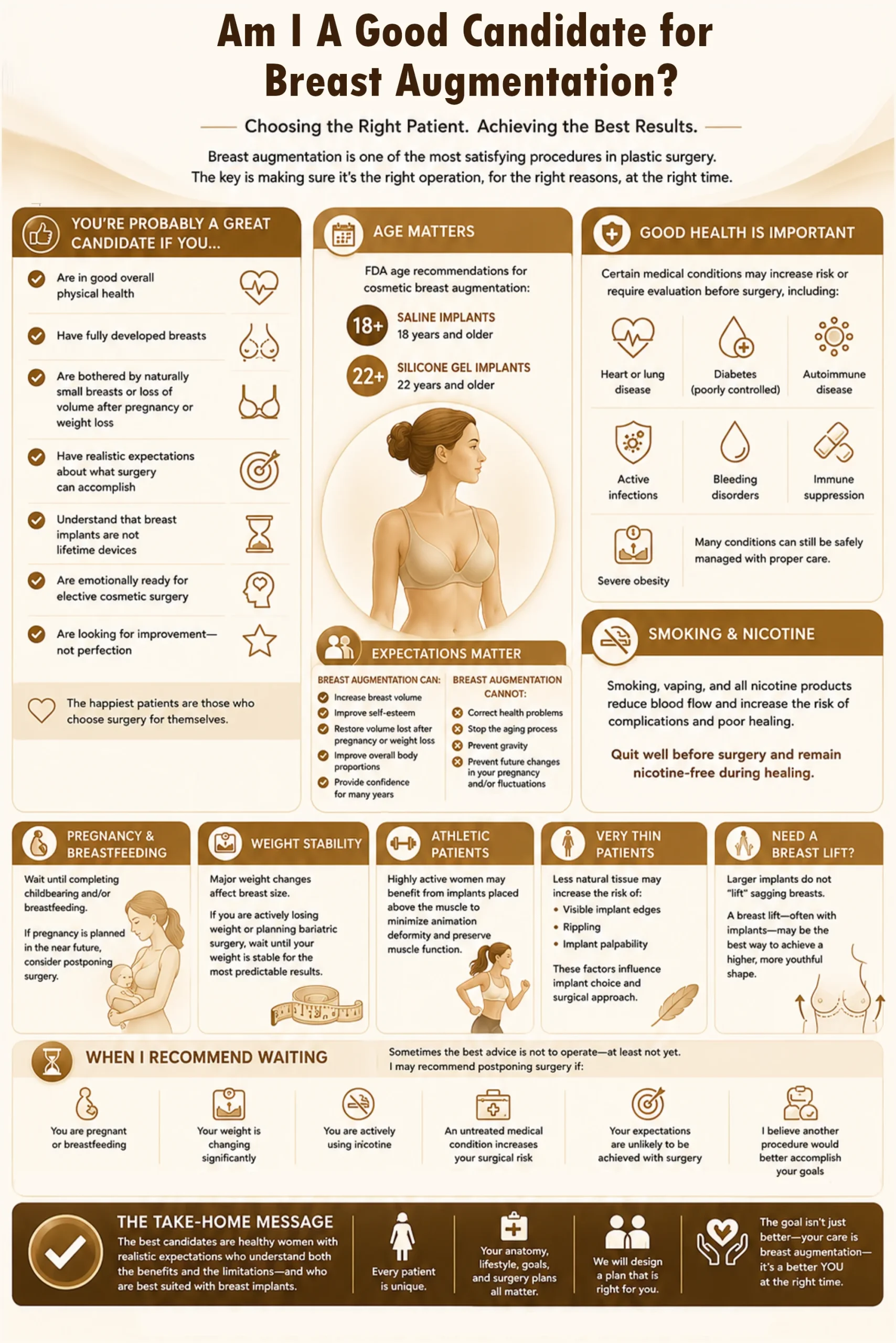
You’re Probably a Great Candidate If…
In general, the best candidates for breast augmentation are healthy women who have realistic expectations and understand both the benefits and the long-term commitment that comes with breast implants. You may be an excellent candidate if you:
- Are in good overall physical health
- Have fully developed breasts
- Are bothered by naturally small breasts or loss of volume after pregnancy or weight loss
- Have realistic expectations about what surgery can accomplish
- Understand that breast implants are not lifetime devices
- Are emotionally ready to undergo elective cosmetic surgery
- Are looking for improvement – not perfection
The happiest patients are usually those who are having surgery for themselves rather than to satisfy someone else’s expectations.
Age Matters
The FDA has established age recommendations for cosmetic breast augmentation.
- Saline implants: 18 years and older
- Silicone gel implants: 22 years and older
These recommendations reflect the FDA approval process and are intended to help ensure that patients are emotionally mature enough to make an informed decision about elective surgery.
Good Health Is Important
Although breast augmentation is very safe, it is still a surgical procedure. Certain medical conditions may increase the risk of complications or require additional evaluation before surgery. These include:
- Poorly controlled diabetes
- Significant heart or lung disease
- Active infections
- Bleeding disorders
- Immune suppression
- Uncontrolled autoimmune disease
- Severe obesity that increases surgical risk
Many women with chronic medical conditions can still safely undergo breast augmentation, but optimization of their health beforehand is important.
A Note on Smoking and Nicotine
Nicotine is one of the few factors that patients can completely control. Smoking, vaping, nicotine gum, nicotine patches, and other nicotine products reduce blood flow to healing tissues and increase the risk of wound-healing problems and infection. If you use nicotine, we strongly recommend stopping well before surgery and remaining nicotine-free throughout the healing process. Simply put, the healthier your tissues are, the better they heal.
Pregnancy and Breastfeeding
If you are currently pregnant, breast augmentation should obviously wait. If you are breastfeeding, our surgeons generally recommend waiting until breastfeeding has ended and your breasts have stabilized before considering surgery.
Likewise, if you are planning to become pregnant in the near future, it may make sense to postpone surgery. Pregnancy, breastfeeding, and the natural changes that accompany them can significantly alter breast size, shape, and skin elasticity. Waiting may help you achieve a more stable and predictable long-term result.
Weight Stability
Major weight changes affect breast size just as they affect the rest of the body. If you are actively losing a significant amount of weight – or planning bariatric surgery – it is usually best to wait until your weight has stabilized. Performing breast augmentation after your weight has reached a stable plateau generally produces a more predictable and longer-lasting result.
Athletic Patients
Women who are highly active often have unique considerations. Weightlifters, CrossFit athletes, climbers, swimmers, tennis players, and others who rely heavily on their pectoralis muscles may be better candidates for implants placed above the muscle to avoid animation deformity and preserve muscle function.
Very Thin Patients
Women with very little natural breast tissue often benefit from a different approach than women who already have moderate breast volume. Thin patients are more likely to experience:
- Visible implant edges
- Rippling
- Implant palpability
These concerns may influence implant selection, implant placement, and whether additional support – such as an internal bra – or fat grafting should be considered.
Why It May be Best to Wait
Occasionally, the best advice a surgeon can give is not to operate – at least not yet. We may recommend postponing surgery if:
- You are pregnant or actively breastfeeding
- Your weight is changing significantly
- You are actively using nicotine
- An untreated medical condition increases your surgical risk
- Your expectations are unlikely to be achieved with surgery
- I believe another procedure would better accomplish your goals
Waiting is not a “no.” It is simply making sure that surgery is performed at the right time and for the right reasons.
What Breast Augmentation Can and Can't Do
One of the greatest predictors of happiness after breast augmentation isn’t the implant you choose, the incision method used, or whether the implant is placed above or below the muscle.
It’s whether your expectations match what surgery can realistically accomplish.
Modern breast augmentation is an incredible procedure, but it is not magic. It can dramatically improve breast size, shape, and proportion – but it cannot change every aspect of your anatomy. Understanding both the possibilities and the limitations is one of the most important steps in planning your surgery.
Breast augmentation is excellent for:
- Increasing breast volume
- Restoring fullness after pregnancy or weight loss
- Improving upper-pole fullness
- Enhancing body proportions
- Improving the way clothing and swimsuits fit
- Increasing confidence for many women
But it has limitations too. Every woman begins with some degree of natural asymmetry: one breast slightly larger, one nipple a little higher, ribs beneath the breasts that are not identical. Most women have never noticed these differences until they begin studying themselves carefully before surgery. Breast augmentation does not create asymmetry – but it also cannot eliminate every natural difference. Our goal is improvement, not perfection.
Cup Sizes Are Not Standardized
One of the most common misconceptions is asking for a specific cup size. The challenge is that cup sizes are not standardized. A “C cup” from one bra manufacturer may fit like a “D cup” from another.
Instead of focusing on a letter, we encourage patients to describe the appearance they want. For example:
- “Natural.”
- “Athletic.”
- “Full, but not obvious.”
- “Noticeable cleavage.”
- “Round upper fullness.”
- “I don’t want people to know I had surgery.”
Those descriptions are much more helpful than trying to chase a particular bra size.
Bigger Is Not Always Better
Many patients assume that a larger implant automatically produces a better result. In reality, the opposite is often true.
Every breast has a natural footprint – its width, skin elasticity, and soft tissue all place limits on the implant that will fit beautifully.
An implant that is too large may:
- Stretch the tissues prematurely
- Increase rippling
- Increase implant visibility
- Increase bottoming out
- Increase the likelihood of future revision surgery
Choosing an implant that matches your anatomy generally produces a more natural appearance and a longer-lasting result.
Cleavage Is Mostly Anatomy
One of the biggest surprises for patients is learning that implants do not create cleavage. Cleavage is determined primarily by:
- Your chest wall shape
- The distance between your breasts
- Your breast footprint
- The position of your nipples
- Your natural anatomy
Implants add volume, but they do not move your breasts closer together. While certain implant choices can enhance cleavage to some degree, every patient has anatomical limits.
Gravity Never Takes a Vacation
Breast implants do not stop the aging process. Your chest skin will continue to age, gravity will continue to take a toll, and changes such as pregnancy, menopause, and weight fluctuation all continue to affect the breasts over time.
A beautiful result today will continue to evolve throughout your lifetime, just as every other part of your body does.
Implants Require Maintenance
Another important expectation involves breast implant longevity. Modern breast implants are extremely durable, but they are not lifetime devices. Most women will eventually have another breast operation because of:
- Implant rupture
- Capsular contracture
- Pregnancy-related changes
- Weight changes
- Desire for a different size
- Implant aging
We generally advise our patients to plan on another breast operation approximately every 15 years, recognizing that some women will need surgery much sooner while others may go decades without any additional procedures.
The Best Results Are Individualized
Today’s patients are exposed to thousands of before-and-after photographs online. While these can be helpful, they can also create unrealistic expectations. Photos may differ because of:
- Different body types
- Different chest widths
- Different implant sizes
- Different lighting
- Different camera angles
- Different posture
- Different stages of healing
The goal should never be to look exactly like someone else. The goal is to create the very best version of you. The happiest patients are the ones whose operation is thoughtfully designed around:
- Their anatomy
- Their lifestyle
- Their goals
- Their future plans
During your consultation, your surgeon can help you understand what is realistically possible. That might mean choosing a different implant than you expected, or adding in a breast lift to improve breast position. Our job as surgeons is not to simply give you the implant you ask for. We are focused on helping you achieve the best long-term result your anatomy will allow.
What to Expect at Your Breast Augmentation Consultation
For many women, the consultation is the most exciting part of the entire breast augmentation journey. It’s also where many of the biggest decisions are made.
One of the most common misconceptions is that a consultation is simply choosing an implant size. In reality, your consultation is a comprehensive evaluation designed to answer one important question: “What operation will give you the safest, most natural, and longest-lasting result?”
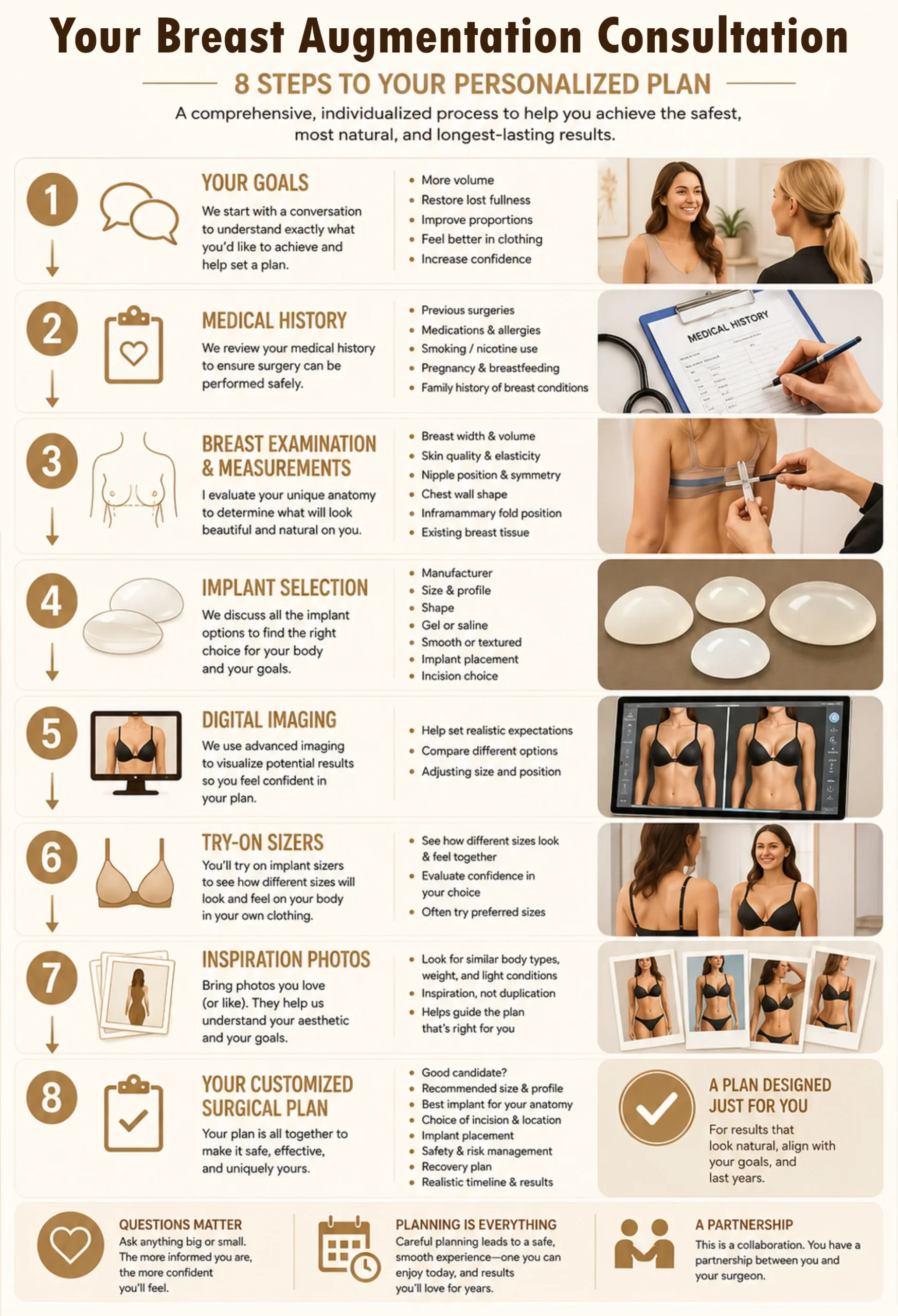
Step 1: Understanding Your Goals
The consultation begins with a conversation – not an examination. Before we ever discuss implants, we want to understand what brought you into the office. There isn’t a “right” answer, and once we have a clear sense of your goals, we can proceed to determine your best breast implant options.
Step 2: Reviewing Your Medical History
We’ll discuss topics such as allergies, current medications, any prior surgeries, and family history to make sure your breast augmentation can be performed safely.
Step 3: Your Breast Examination
This is where surgery becomes personalized.
During your examination, your surgeon will carefully assess:
- Breast width
- Skin quality and elasticity
- Breast volume
- Nipple position
- Degree of asymmetry
- Chest wall shape
- Position of the inframammary fold
- Thickness of your breast tissue
- Existing breast ptosis (sagging)
Step 4: Choosing the Right Implant
Now the fun begins. We’ll discuss the many decisions involved in choosing an implant, including:
- Manufacturer
- Implant size
- Profile
- Gel cohesivity
- Implant shell
- Implant placement
- Incision choice
Step 5: Digital Imaging
One of the most helpful tools available today is digital imaging. While no computer simulation can perfectly predict your final result, Vectra 3D imaging allows us to visualize different implant sizes and profiles on your own body. Think of it as another planning tool – not a guarantee.
Step 6: Trying On Implant Sizers
This is often a patient’s favorite part of the consultation. You’ll place implant sizers inside a bra so you can actually see how different volumes look on your own body. Most patients quickly discover that the implant they thought they wanted isn’t necessarily the one they prefer once they see it in the mirror.
Step 7: Inspiration Photos
We encourage patients to bring photographs of results they like. As you collect inspiration photos, look for women with:
- A body type similar to yours
- Similar chest width
- Similar shoulder and hip proportions
- Similar starting breast size
A beautiful result on someone with a completely different body may not be achievable – or even desirable – for you. The goal is inspiration, not duplication.
Step 8: Building Your Surgical Plan
By the end of your consultation, we have gathered everything needed to design your surgery. Together we’ll determine:
- Whether you’re a good candidate
- Whether you need implants alone or a lift as well
- Which implant best fits your anatomy
- Above or below the muscle
- Incision location
- Whether additional support, such as an internal bra, may be beneficial
- What result you can realistically expect
Every recommendation we make is individualized. In many cases, our surgeons spend more time planning a breast augmentation than actually performing it. The planning that precedes surgery is what allows us to achieve beautiful, natural, and predictable results. Great outcomes begin with listening carefully, understanding your goals, making thoughtful measurements, and creating a plan that is uniquely yours.
Breast Position: Do You Need a Breast Lift?
Larger implants alone will not “lift” sagging breasts. Breast implants restore volume and fullness, but they do not significantly elevate the nipple or remove excess skin. If the nipple has descended significantly or the breast skin has stretched over time, a breast lift may be necessary to reposition the breast into a more youthful shape.
In many cases, the best operation is actually a breast lift with augmentation, rather than implants alone. Determining whether you need a lift is one of the most important decisions in planning breast surgery. Choosing implants alone when a lift is actually needed often results in breasts that are larger – but still droopy.
About Breast Ptosis
Ptosis is the medical term for drooping of the breast. Over time, the skin and supporting ligaments gradually stretch, allowing the breast tissue and nipple to descend. While loss of volume can make the breast appear deflated, ptosis refers specifically to the position of the nipple relative to the inframammary fold.
Plastic surgeons typically classify breast ptosis into three grades.
- Grade I (Mild): The nipple sits at the level of the inframammary fold or only slightly below it. Many women with mild ptosis can achieve an excellent result with implants alone.
- Grade II (Moderate): The nipple has descended below the inframammary fold but still points forward. These patients frequently benefit from combining an implant with a breast lift.
- Grade III (Severe): The nipple sits well below the inframammary fold and points downward toward the floor. A breast lift is almost always necessary to restore proper breast shape and nipple position.
A simple screening tool many of our patients have heard about is the Pencil Test. To perform this test, place a pencil underneath your breast. If the pencil immediately falls to the floor, there is generally minimal skin excess. If the pencil remains trapped beneath the breast without falling, it usually indicates enough breast overhang that a lift should at least be considered.
Although the Pencil Test is not a substitute for a professional examination, it provides an easy way to understand how excess skin contributes to breast ptosis.
Breast Lift Techniques
When a patient truly needs a breast lift, our preferred operation is the Wise Pattern (Anchor) Mastopexy. Although it creates additional scars compared with smaller-incision techniques, the anchor lift remains the gold standard for women with moderate or significant ptosis because it allows excellent breast reshaping, reliable nipple elevation, and better long-term breast shape.
Our surgeons rarely recommend the circumareolar, or donut, lift. The concept is certainly appealing – a scar only around the areola with no vertical or inframammary scar. But a circumareolar lift provides only a limited amount of lifting power and is generally incapable of correcting moderate or severe breast ptosis. Patients often end up with a breast that remains droopy despite surgery.
Because the entire lifting force is concentrated around the areola, the scar can stretch over time, leaving a widened areola and a conspicuous circular scar. The breast itself may also appear flattened rather than attractively projected.
Comparing Your Options
| Implant Alone | Implant + Lift |
|---|---|
| Restores volume | Restores volume and breast position |
| No significant nipple elevation | Raises the nipple |
| Best for minimal ptosis | Best for moderate or severe ptosis |
| Smaller scars | Additional lift scars |
| May leave persistent drooping if ptosis exists | Most youthful overall breast shape |
Choosing a Breast Lift
One of the hardest conversations in breast surgery is telling a patient that she needs a lift when she was hoping to avoid additional scars. Every surgeon wishes they could create a beautifully lifted breast without making lift incisions – but unfortunately, skin simply doesn’t shrink enough to accomplish that.
Our patients are almost always happier with a well-performed lift and a beautifully shaped breast than with a smaller scar but a breast that still hangs lower than they expected. There will always be tradeoffs, but we find that choosing the operation that gives you the best breast shape and best symmetry is worth having some amount of scarring.
Internal Bras: Do You Need One?
You’ve probably heard the term “internal bra“ while researching breast augmentation or breast lift surgery. Although it sounds like an implant or a permanent sling, that’s not actually what it is.
An internal bra is a specialized surgical mesh that reinforces the lower portion of the breast, providing additional support while your body’s own tissues heal and strengthen. While it isn’t necessary for most patients, it can be an invaluable tool in carefully selected situations.
Rather than supporting the breast forever, an internal bra provides reinforcement during healing while encouraging your own tissue to grow into and strengthen the repair. Think of it as reinforcing the foundation of a house – it doesn’t change the appearance directly, but it helps support the overall structure.

When an Internal Bra May Help
- Poor Quality Breast Tissue: Some women naturally have very thin or weak breast tissue, while others develop tissue stretching after pregnancy, breastfeeding, significant weight loss, or aging. Additional support can help maintain implant position over time.
- Larger Breast Implants: The larger an implant becomes, the greater the downward force placed on the breast. An internal bra can help reinforce the lower breast and reduce the risk of stretching over time.
- Previous Bottoming Out or Implant Malposition: Patients undergoing revision surgery because an implant has descended too low often benefit from additional internal support. An internal bra helps reinforce the repair while healing occurs.
- Patients Who Prefer a Higher Implant Position: Some women prefer a fuller upper breast with implants that maintain a higher position on the chest. An internal bra may help support that surgical goal in carefully selected patients.
- Above-the-Muscle Implant Placement: When implants are placed above the pectoralis muscle – whether in the subfascial or subglandular plane – the breast tissue itself becomes the primary source of implant support. Unlike submuscular placement, there is no additional muscular coverage helping to stabilize the implant.
For patients with thinner tissues, larger implants, or concerns about long-term stretching, an internal bra can provide additional reinforcement to the lower pole of the breast. This added support may help maintain implant position, preserve breast shape, and reduce the risk of progressive tissue stretching over time.
Synthetic Mesh Internal Bras
Examples include:
- Galaflex®
- DuraSorb®
These materials provide temporary structural support while gradually being absorbed by the body over time. As they dissolve, your own tissue assumes the supporting role. Synthetic meshes work well in many primary breast procedures where additional reinforcement is desired but permanent structural support isn’t necessary.
Biologic Mesh Internal Bras
Examples include:
- Strattice® (derived from porcine tissue)
- AlloDerm® (derived from donated human dermis)
These biologic materials are processed to remove living cells, leaving behind a collagen scaffold that becomes incorporated into the patient’s own tissue. Because they provide more substantial reinforcement, our surgeons generally reserve biologic meshes for patients who require the greatest degree of structural support – particularly complex revision surgery, significant tissue weakness, or recurrent implant malposition.
Our Philosophy
Most breast augmentation surgeries do not need an internal bra. For the majority of patients with healthy tissue and appropriately sized implants, meticulous surgical technique alone provides excellent long-term support.
However, when the anatomy or surgical goals place additional demands on the breast, an internal bra can provide valuable reinforcement and improve long-term stability.
What About Fat Transfer or alloClae Injections?
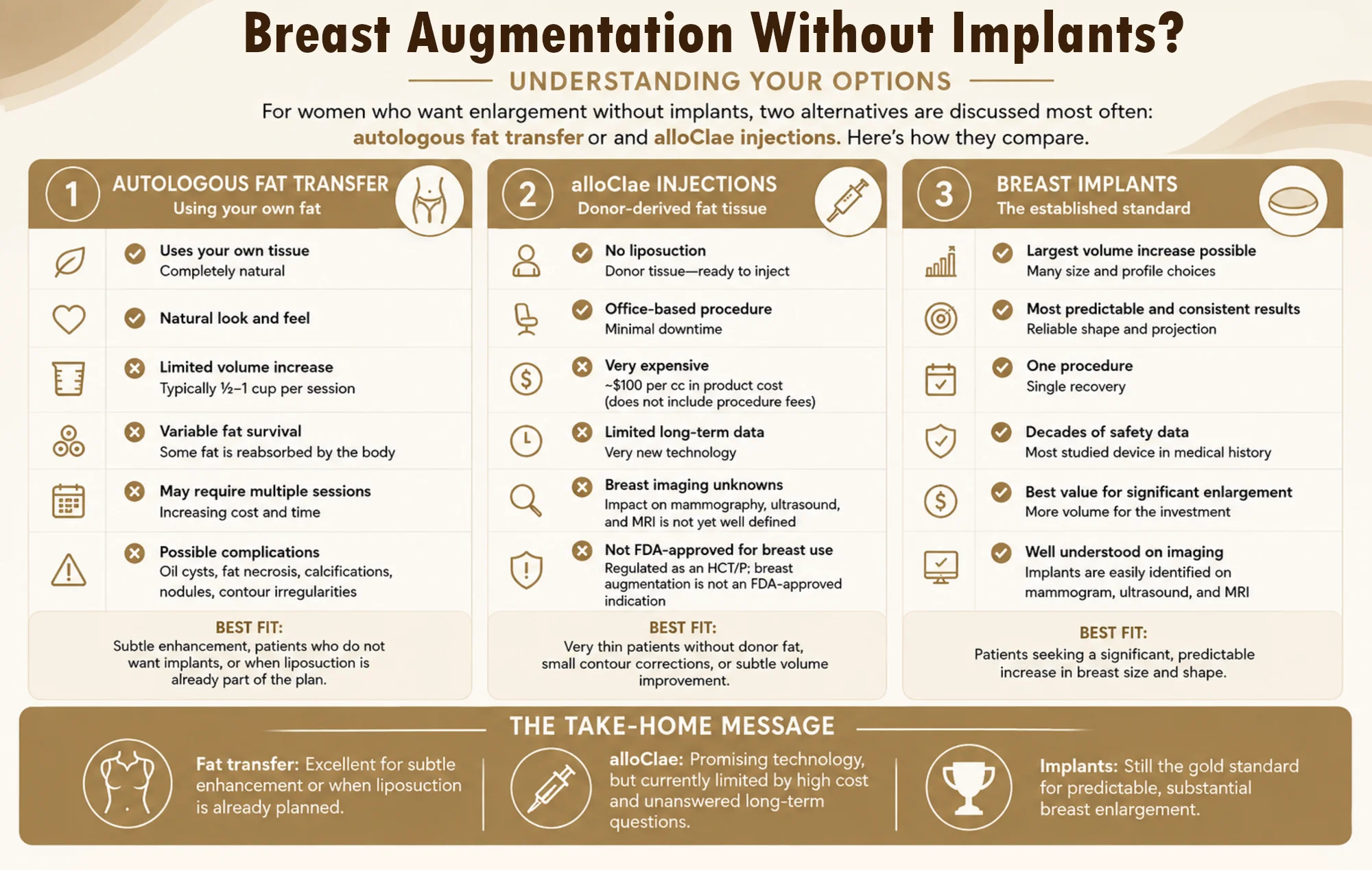
For women who want breast enlargement without an implant, two alternatives are increasingly discussed: fat transfer using your own fat and alloClae, an injectable product made from donated human fat tissue.
Both can provide additional breast volume, but neither currently offers the predictable size, shape, and projection that can generally be achieved with a breast implant.
Autologous Fat Transfer
“Autologous” simply means that the tissue comes from your own body. With fat-transfer breast augmentation, fat is removed from areas such as the abdomen, waist, hips, or thighs using liposuction. It is then processed and carefully injected into the breasts.
The principal advantage is obvious: the breast is enlarged using your own tissue rather than an implant. However, fat transfer has several significant limitations.
The Amount of Enlargement Is Limited
Only a certain amount of fat can safely survive during each treatment. In most patients, fat grafting produces a relatively modest increase—often approximately one-half to one cup size per breast during a session.
Some of the transferred fat will be permanently retained, while some will be absorbed by the body. The final retained volume can therefore be less predictable than the volume obtained with an implant.
Patients seeking a more substantial change may require multiple procedures, making the process increasingly expensive and time-consuming.
Fat Grafting Is Not Risk-Free
Transferred fat can occasionally form:
- Oil cysts
- Areas of fat necrosis
- Firm nodules
- Calcifications
- Contour irregularities
- Infection
- Asymmetry or uneven fat absorption
These changes are usually benign, but they may sometimes be felt during an examination or appear on future breast imaging. An experienced breast radiologist can generally distinguish typical postoperative fat-grafting changes, although additional imaging or occasionally a biopsy may be recommended when a finding is uncertain.
When Fat Transfer Makes the Most Sense
At our practice, fat transfer has its greatest value when a patient:
- Strongly prefers not to have breast implants
- Wants only a subtle increase in volume
- Understands that more than one procedure may be necessary
- Is already undergoing liposuction
- Has a specific contour irregularity that would benefit from targeted filling
When liposuction is already part of the surgical plan, repurposing some of the aspirated fat for a modest breast enhancement can be very reasonable. The liposuction is already being performed, the fat would otherwise be discarded, and even a limited improvement may be worthwhile.
For a patient whose primary goal is a predictable increase of several cup sizes, however, fat transfer alone is usually not the most efficient or reliable option.
What Is alloClae?
alloClae is a relatively new, ready-to-use injectable product made from sterilized donated human adipose tissue. Unlike traditional fat grafting, it does not require liposuction because the tissue comes from a screened human donor rather than from the patient.
The manufacturer describes the product as containing nonliving fat cells, extracellular matrix, lipids, and connective tissue. It is designed to provide structure, cushioning, and volume in areas where fat naturally exists.
In simple terms, alloClae is intended to function somewhat like an “off-the-shelf” fat graft. Its potential advantages include:
- No donor-site liposuction
- An office-based injection procedure
- Limited downtime
- Immediate targeted volume
- An option for very thin patients who do not have enough fat to harvest
It may eventually prove useful for correcting small contour defects or providing subtle soft-tissue enhancement. However, we currently have two major reservations about using it for breast augmentation.
Concern No. 1: Cost
Breast augmentation requires a meaningful amount of volume. A typical breast implant may contain several hundred cubic centimeters, while alloClae is priced by the cubic centimeter.
The product cost is currently approximately $100 per cc, before including the surgeon’s fee, facility costs, anesthesia or local anesthetic, supplies, and follow-up care.
At that price, even a relatively small breast-volume increase can become extremely expensive. Creating the volume of an average breast implant could be economically unrealistic for most patients.
Therefore, while alloClae may be practical for a small indentation or limited contour correction, its economics become difficult to justify when large-volume breast enhancement is the goal.
Concern No. 2: Breast-Cancer Surveillance
alloClae is new, and there is not yet a substantial body of long-term published evidence describing how large-volume injections will appear on:
- Mammography
- Breast ultrasound
- Breast MRI
- Long-term physical examinations
Traditional fat grafting can produce oil cysts, calcifications, fat necrosis, and palpable nodules. Because alloClae is also an adipose-tissue product, it is reasonable to ask whether it may produce imaging changes or palpable abnormalities that could complicate future breast-cancer surveillance.
At present, we simply do not have enough long-term breast-specific evidence to answer that question confidently. That does not prove that alloClae will interfere with cancer detection. It means that the effect remains uncertain—and uncertainty deserves particular caution when introducing a new product into the breast.
Is alloClae FDA-Approved for Breast Augmentation?
No. alloClae is not FDA-approved or cleared specifically as a breast-augmentation product.
It is regulated as a human cell, tissue, and cellular or tissue-based product, commonly called an HCT/P. Certain HCT/Ps may be marketed without the same premarket approval process required for a new drug, medical device, or breast implant.
You may see alloClae described as “FDA regulated,” “FDA compliant,” or sometimes even “FDA approved.” These phrases are not interchangeable. FDA regulation as donated human tissue does not mean the FDA has reviewed and approved alloClae specifically for cosmetic breast enlargement.
For patients, the practical takeaway is straightforward: using alloClae for breast augmentation is not an FDA-approved breast indication, and long-term breast-specific safety and imaging data remain limited.
Request Your Consult
Meet Our Doctors
Our surgeons are dedicated to creating beautiful, natural results so you can look and feel your very best.