Breast Implant Techniques
Beyond characteristics of the selected breast implants themselves, decisions about how the implant will be placed can affect overall appearance and patient satisfaction, both immediately after surgery and for years to come.
This page reviews the techniques involved in placing breast implants, reviews implant incision options, and discusses a newer technique that allows our surgeons to perform the breast augmentation procedure in a less invasive way.
Breast Implant Placement
One of the most important decisions in breast augmentation is where the implant will be placed. Although patients often focus on implant size, implant placement may have an even greater impact on the final result.
Modern breast implants can generally be placed in one of two locations:
- Above the pectoralis muscle (subglandular or subfascial)
- Below the pectoralis muscle (dual-plane submuscular)
Each position has distinct advantages and tradeoffs. The “best” location depends on your anatomy, lifestyle, and goals – not simply surgeon preference.
Above the Muscle Placement
When an implant is placed above the pectoralis muscle, it rests beneath the breast tissue itself. There are two variations of this approach.
- Subglandular Placement: The implant sits directly beneath the breast tissue and above the pectoralis muscle.
- Subfascial Placement: The implant is placed beneath the thin layer of fascia covering the pectoralis muscle while leaving the muscle itself completely intact.
Although the fascia is only a thin layer of connective tissue, many surgeons believe it provides modest additional support while preserving the advantages of above-the-muscle placement. In practical terms, both techniques preserve normal pectoralis muscle function and behave similarly.
Advantages of Above-the-Muscle Placement
Because the pectoralis muscle is left undisturbed:
- Recovery is often faster.
- Postoperative discomfort is generally less.
- Normal chest muscle function is preserved.
- There is little or no animation deformity.
- Implant shape remains stable during exercise.
This has become an increasingly attractive option for women with active lifestyles.
Tradeoffs of Above-the-Muscle Placement
The primary limitation is soft tissue coverage. Because the implant is covered only by the patient’s natural breast tissue:
- Implant edges may be more visible.
- Rippling is more likely in thin patients.
- Thin tissues may reveal implant contours more readily.
For this reason, careful patient selection is essential.
Best Candidates for Above-the-Muscle Placement
In our practice, we most commonly recommend above-the-muscle placement for women who have:
- Adequate natural breast tissue to camouflage the implant
- Active lifestyles involving significant chest muscle use
- A desire to preserve normal pectoralis muscle function
- Moderate implant size goals
- A naturally rounder chest wall, where muscle forces may otherwise encourage lateral implant displacement
For these patients, preserving normal muscle function often outweighs the additional coverage provided by submuscular placement.
Real Patient Examples
Sensitive Content
These before and after photos contain nudity. Please click/tap to view the images.
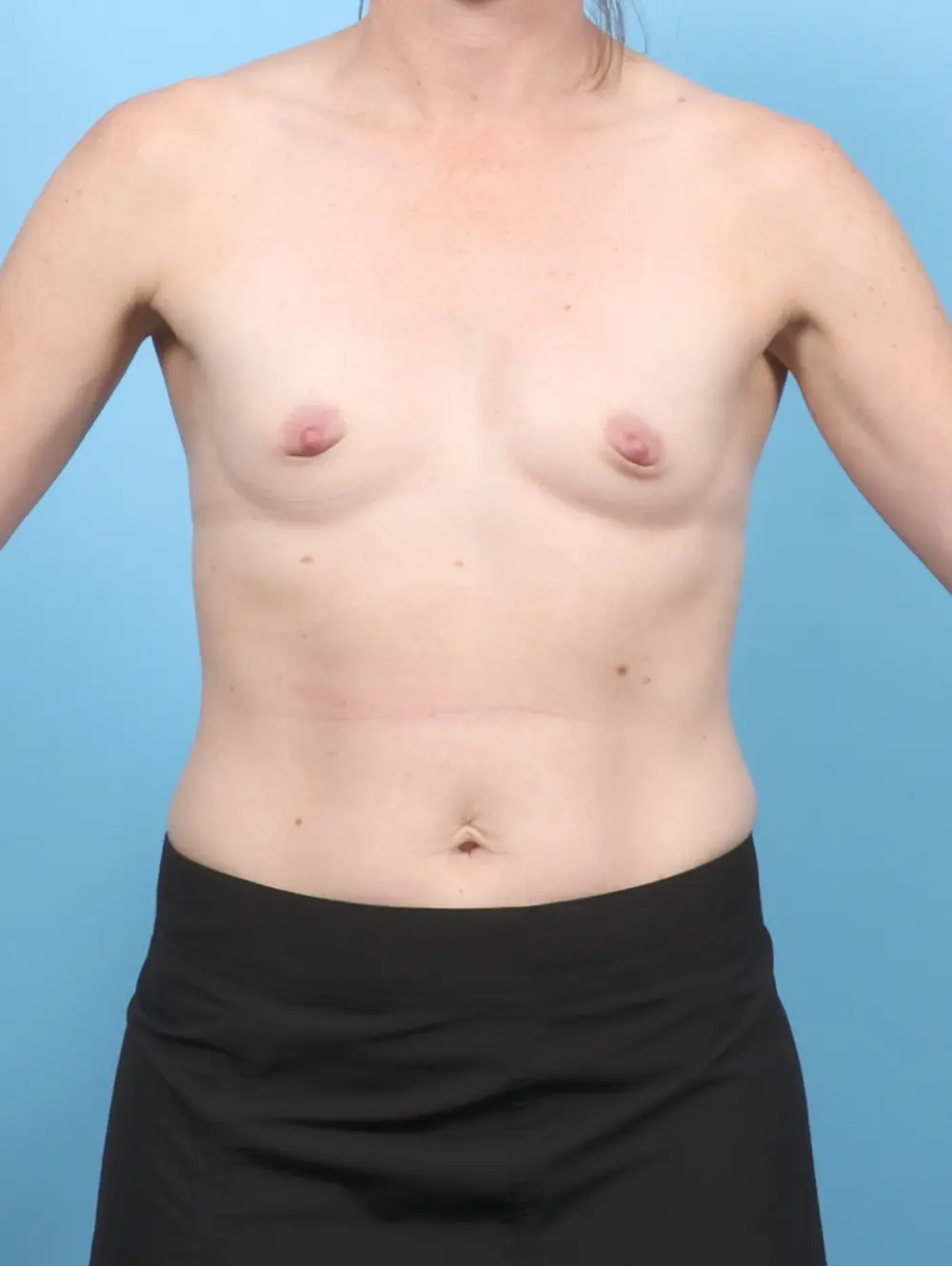
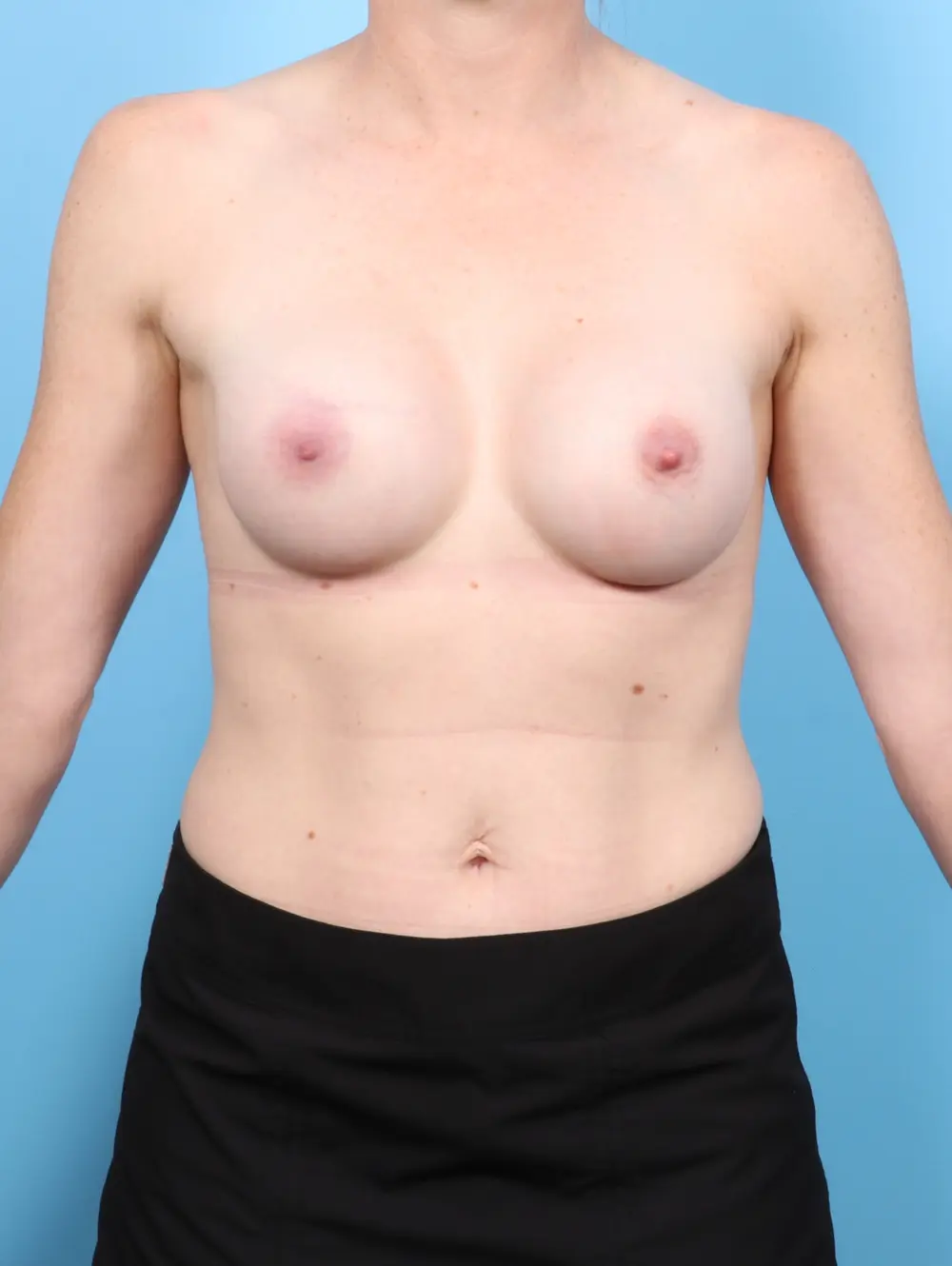
This 41-year-old woman from Folsom, California, is 5'4" and approximately 128 pounds. She is extremely athletic, and her career is also physically demanding. She underwent breast augmentation with 325 cc Allergan moderate profile extra-cohesive silicone gel implants placed above the muscle, with an internal bra added for additional support and control of implant position.
Her six-month result demonstrates beautiful symmetry and natural, size-appropriate breasts that complement her athletic frame. For this patient, above-the-muscle placement was an important part of the surgical plan. Given her active lifestyle and heavy use of her chest muscles, avoiding a submuscular pocket reduces the potential for animation deformity and unwanted implant movement with muscle contraction. This case demonstrates why implant placement should be individualized—not simply based on a preferred technique, but on each patient’s anatomy, lifestyle, and aesthetic goals.

Sensitive Content
These before and after photos contain nudity. Please click/tap to view the images.
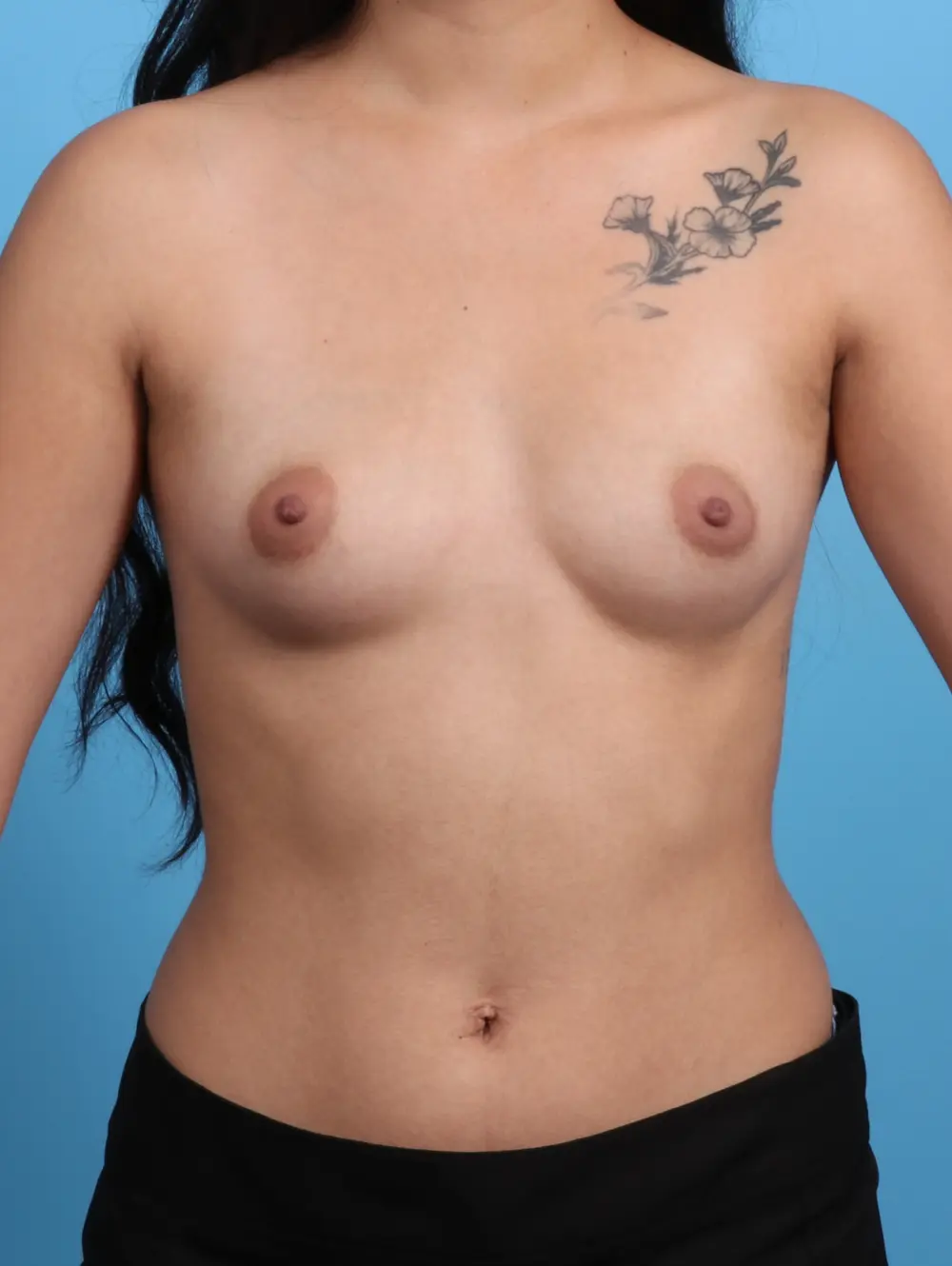
This 24-year-old woman is 5'6" and approximately 119 pounds. She underwent breast augmentation with 470 cc Sientra high-profile, extra-cohesive silicone gel implants placed below the muscle using a dual-plane technique. The implants were inserted through incisions concealed within the inframammary folds. Her result demonstrates beautiful cleavage, excellent implant position, and an intentionally fuller, more augmented appearance consistent with her aesthetic goals.
This case illustrates an important principle of breast augmentation: a successful result is not defined by subtlety alone. For patients who desire a more noticeable augmentation, thoughtful implant selection and precise pocket creation can provide greater fullness while maintaining attractive shape, symmetry, and proportion.
Below the Muscle Placement
Although commonly referred to as “under the muscle,” modern breast augmentation is almost always performed using a dual-plane technique.
In a dual-plane augmentation, the upper portion of the implant is covered by the pectoralis major muscle, while the lower portion is covered only by the breast tissue.
The lower attachments of the pectoralis muscle are partially released, allowing the implant to settle naturally into the lower breast.
This creates several advantages:
- Improved upper pole coverage
- A smoother transition from the chest wall to the breast
- Better expansion of the lower breast
- More natural implant positioning
Importantly, the implant is not completely beneath the muscle. Only the upper portion is covered by muscle, while the lower pole remains beneath the breast tissue.
This is why the term dual-plane is a more accurate description than simply “under the muscle.”
Advantages of Dual-Plane Placement
The pectoralis muscle provides additional soft tissue coverage over the upper portion of the implant. This additional coverage can:
- Better camouflage the implant.
- Reduce visible implant edges.
- Decrease the likelihood of rippling.
- Create a smoother upper breast contour.
These advantages are particularly important in women with very little natural breast tissue.
Tradeoffs of Dual-Plane Placement
Because the implant interacts with the pectoralis muscle, it is influenced whenever the muscle contracts. This may result in:
- Animation deformity
- Temporary implant movement during chest exercises
- Distortion when flexing the pectoralis muscle
Although many women are never bothered by animation deformity, highly athletic patients who frequently engage their chest muscles often notice it. Recovery may also be somewhat longer because the pectoralis muscle has been elevated during surgery.
Best Candidates for Dual-Plane Placement
I most commonly recommend dual-plane augmentation for women who have:
- Very little natural breast tissue
- Thin soft tissue coverage
- A flatter chest wall
- A greater need for upper pole camouflage
- Less involvement in activities requiring repetitive pectoralis muscle activation
The additional muscle coverage often produces a softer transition and helps conceal the implant more effectively.
Comparing Implant Placement
| Above the Muscle (Subglandular/Subfascial) | Below the Muscle (Dual Plane) |
|---|---|
| Faster recovery | Slightly longer recovery |
| Less postoperative discomfort | More muscle soreness initially |
| Preservés pectoralis function | Muscle influences implant movement |
| Minimal animation deformity | Possible animation deformity |
| More visible implant edges in thin patients | Better implant camouflage |
| Greater chance of rippling | Less visible rippling |
| Excellent for active women | Excellent for women with limited breast tissue |
Our Perspective on Implant Placement
There has been a significant evolution in implant placement over the past decade.
Historically, most surgeons preferred placing implants beneath the muscle because it provided additional soft tissue coverage. While that remains an excellent option for many women, improvements in implant technology, surgical technique, and patient selection have expanded the role of above-the-muscle augmentation.
Our surgeons increasingly individualize implant placement based on the patient’s anatomy and lifestyle rather than following a one-size-fits-all philosophy.
- For a thin woman with very little natural breast tissue, dual-plane placement often provides the most natural result.
- For an athletic patient with adequate breast tissue who values unrestricted pectoralis muscle function and wants to avoid animation deformity, above-the-muscle placement may be the better choice.
There is no universally superior implant position. The best choice is the one that best matches the patient’s anatomy, goals, and lifestyle.
Breast Implant Incision Choices
Almost all women considering breast augmentation want to know more about where the incision will be, and how noticeable the scar might be. While the scar itself is important, the incision does much more than determine where the scar will be located.
The incision influences:
- Surgical exposure
- Implant handling
- Sterility
- Risk of capsular contracture
- Future revision surgery
- Long-term breast aesthetics
Several different incisions can produce beautiful breast augmentations. In our practice, our surgeons generally follow one approach that offers significant advantages for both the initial surgery and the decades that follow.
The Three Most Common Incisions
- Inframammary Fold (IMF): The incision is placed within the natural crease beneath the breast. This is currently the most commonly used incision in modern breast augmentation and has become the preferred approach for our surgeons.
- Periareolar: The incision follows the lower border of the areola, where the darker areolar skin meets the surrounding breast skin. Because the scar lies along this natural color transition, it can heal quite inconspicuously in selected patients.
- Transaxillary: The incision is hidden within the natural folds of the armpit. No scar is placed on the breast itself, which is appealing to some patients. However, this advantage comes with important limitations.
Why We Prefer the Inframammary Fold
The inframammary fold provides outstanding visualization throughout the operation. Excellent exposure allows precise pocket dissection, accurate implant positioning, and controlled implant insertion.
It also minimizes unnecessary manipulation of the implant as it enters the breast pocket. Perhaps most importantly, the incision avoids passing through breast ducts.
Several studies have suggested that reducing bacterial contamination during implant placement may decrease the risk of capsular contracture. Because the inframammary incision avoids breast duct tissue, many surgeons believe it offers an advantage in minimizing bacterial exposure during surgery.
Although no surgical approach completely eliminates the possibility of capsular contracture, our surgeons have found that the inframammary fold provides the most controlled and reproducible method of implant placement.
Our Perspective on Periareolar Incisions
The periareolar incision certainly has advantages. In appropriately selected patients, the scar can blend beautifully with the natural border of the areola.
However, our surgeons use this incision far less frequently. One reason is that the incision passes through breast tissue and ducts before reaching the implant pocket, potentially increasing bacterial exposure.
More importantly, this incision method can offer disadvantages for future surgeries. Many women will undergo a second breast procedure years later because of aging, pregnancy, changes in preference, implant rupture, or revision surgery.
Reusing a periareolar incision for revision surgery can occasionally produce scar tethering, contour irregularities, or dimpling of the lower areola. For that reason, our surgeons generally prefer preserving the areola whenever possible.
Our Perspective on Transaxillary Incisions
The transaxillary approach appeals to patients because there is no scar on the breast. While this is an attractive concept, our surgeons rarely recommend it.
Although primary augmentation can be performed successfully through the armpit, future revision surgery is far more challenging through this approach. Many women eventually undergo additional breast surgery during their lifetime.
Whether replacing implants, adjusting implant position, performing a breast lift, or correcting a complication, those operations almost always require an incision on the breast itself.
Because of this, the initial benefit of avoiding a breast scar is often temporary. Our surgeons prefer choosing an incision that provides excellent exposure today while preserving the easiest path for any surgery that may be needed years later.
Comparing the Incisions
| Inframammary Fold | Periareolar | Transaxillary |
|---|---|---|
| Excellent surgical exposure | Good exposure | More limited exposure |
| Avoids breast ducts | Passes through breast ducts | Avoids breast ducts |
| Lowest bacterial contamination potential | Higher theoretical bacterial exposure | Variable |
| Excellent for revision surgery | Revision may affect areolar contour | Revision usually requires a new breast incision |
| Scar hidden in breast fold | Scar along areolar border | Scar hidden in armpit |
| Our preferred approach | Selected situations | Rarely used in our practice |
Our Perspective on Breast Implant Incisions
Every incision can produce an excellent breast augmentation when performed thoughtfully. Our surgeons prefer the inframammary fold method because it offers the greatest advantages over a patient’s lifetime, not because it creates a dramatically better cosmetic result on day one.
The inframammary incision provides excellent surgical exposure, minimizes implant handling, avoids traversing breast ducts, and facilitates future surgery if it ever becomes necessary.
When our surgeons recommend an incision, they are thinking not only about today’s operation, but about how that decision may affect you ten, twenty, or even thirty years from now.
Breast augmentation is not just about creating a beautiful result today – it’s about preserving that result and making future care as straightforward as possible.
The Preservé™ Breast Augmentation Technique
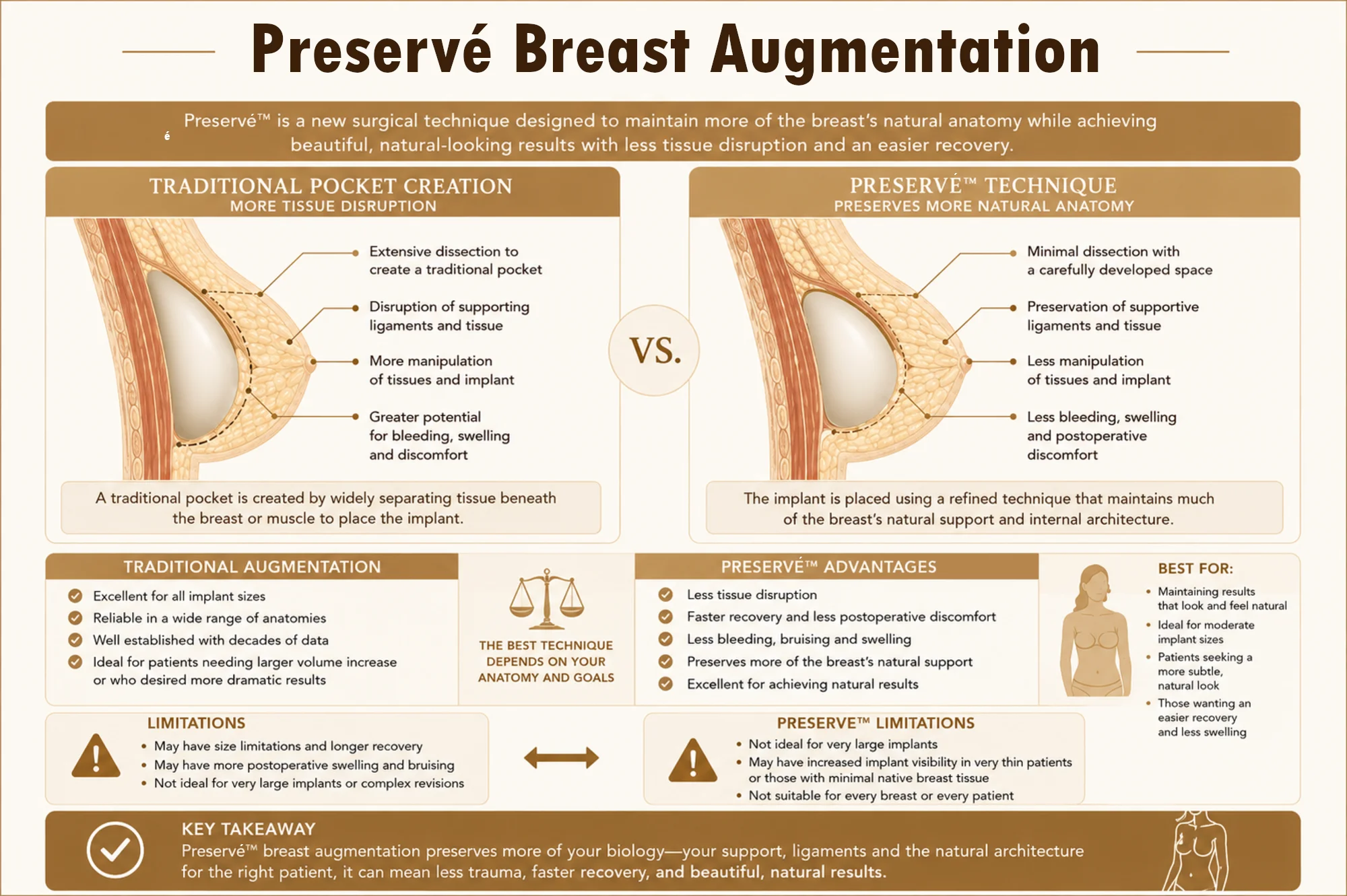
Breast augmentation has traditionally required creating a pocket by separating tissue beneath the breast or beneath the pectoralis muscle. While these techniques have produced beautiful results for decades, they inevitably involve some disruption of normal anatomy.
The Preservé™ Breast Augmentation technique represents a fundamentally different philosophy.
Rather than creating a traditional implant pocket through blunt dissection, Preservé is designed to maintain as much of the breast’s natural anatomy as possible. By preserving supportive tissues and minimizing disruption, the procedure aims to reduce surgical trauma while maintaining excellent implant support.
Although this technique is still relatively new, we believe it represents one of the most exciting advances in breast augmentation in many years and has the potential to become a true game changer for appropriately selected patients.
What Is Preservé Breast Augmentation?
Preservé is a modern surgical technique that places the implant while minimizing disruption of the breast’s natural supporting structures. Instead of widely separating tissues to create a pocket, the implant is inserted through a carefully developed space that preserves much of the breast’s internal architecture.
The goal is simple:
- Preservé normal anatomy
- Reduce tissue trauma
- Maintain natural support
- Promote faster recovery
Think of it as minimally invasive surgery applied to breast augmentation.
The Preservé™ Technique - Step-by-Step
Potential Advantages
- Less Tissue Disruption: Because less tissue is separated during surgery, there is less surgical trauma to the breast.
- Faster Recovery: Many patients experience less postoperative discomfort and return to normal activities sooner than with traditional techniques.
- Better Preservation of Natural Anatomy: Maintaining the breast’s supporting structures may help preserve natural breast mechanics and implant support.
- Less Bleeding and Swelling: Reduced tissue dissection may result in less bruising and postoperative swelling.
- Excellent Implant Stability: Preserving internal support structures may help maintain accurate implant positioning.
Who Is a Good Candidate?
Preservé is best suited for patients who:
- Desire a natural-looking augmentation
- Want a moderate increase in breast size
- Have reasonable native breast tissue
- Value a quicker recovery
- Prefer a less invasive surgical approach
These patients often achieve outstanding results with minimal disruption of their normal anatomy.
What Are the Limitations?
Like every surgical technique, Preservé is not appropriate for every patient.
Very Large Implants
One of the primary limitations is implant size. Because Preservé relies on maintaining much of the breast’s natural support, there is a practical limit to how large the implant can be while still preserving those tissues.
Patients seeking a dramatic increase in breast size may be better served with traditional techniques.
Very Thin Patients
Women with very little native breast tissue may experience greater implant palpability because there is less tissue available to camouflage the implant.
In these patients, traditional submuscular or dual-plane techniques may still provide superior soft-tissue coverage.
Not Every Breast Is the Same
Previous surgery, significant asymmetry, chest wall anatomy, or complex breast deformities may make traditional techniques a better choice.
The best operation is always the one that matches the patient’s anatomy – not simply the newest technique.
How Preservé Compares
| Traditional Augmentation | Preservé Technique |
|---|---|
| Creates a traditional implant pocket | Preservés more natural supporting tissues |
| More tissue dissection | Less tissue disruption |
| Excellent for all implant sizes | Best for small to moderate implant sizes |
| Well established with decades of data | Newer technique with growing clinical experience |
| Excellent option for complex anatomy | Excellent option for selected patients seeking a less invasive approach |
Our Perspective on Preservé
Our surgeons have always believed that good surgery is about respecting normal anatomy whenever possible.
In this context, the Preservé philosophy makes sense: if we can achieve the same beautiful result while disrupting less normal tissue, patients may benefit from an easier recovery and potentially preserve more of the breast’s natural support.
That doesn’t mean Preservé is the right answer for everyone. Patients seeking very large implants, those with minimal breast tissue, or women with more complex anatomy may still be better served with traditional breast augmentation techniques.
Rather than forcing every patient into the newest operation, we believe in selecting the technique that best fits each individual’s anatomy and aesthetic goals. Preservé has become an exciting addition to our surgical toolbox, and we expect its role will continue to grow as we gain more long-term experience.
Request Your Consult
Meet Our Doctors
Our surgeons are dedicated to creating beautiful, natural results so you can look and feel your very best.