Breast Implant Options
When women begin researching breast augmentation, one of the first questions they often ask is:
“Which breast implant is the best?”
The answer is more complicated – and more interesting – than most patients realize. Let’s take a closer look at all aspects of breast implant options, from the companies offering breast implants in the U.S. to the technology behind modern implants, as well as the technical aspects of implants such as shape and profile.
With a complete understanding of your breast implant options, you can make an informed choice to have implants that provide years of satisfaction.
About Breast Implant Manufacturers
Today, women in the United States have access to several excellent FDA-approved breast implant manufacturers. Each company has invested decades in research, engineering, and clinical studies to develop implants that are safe, durable, and capable of producing beautiful results.
However, breast implants are not identical. Each manufacturer has its own history, design philosophy, shell technology, gel characteristics, implant shapes, warranty programs, and available options.
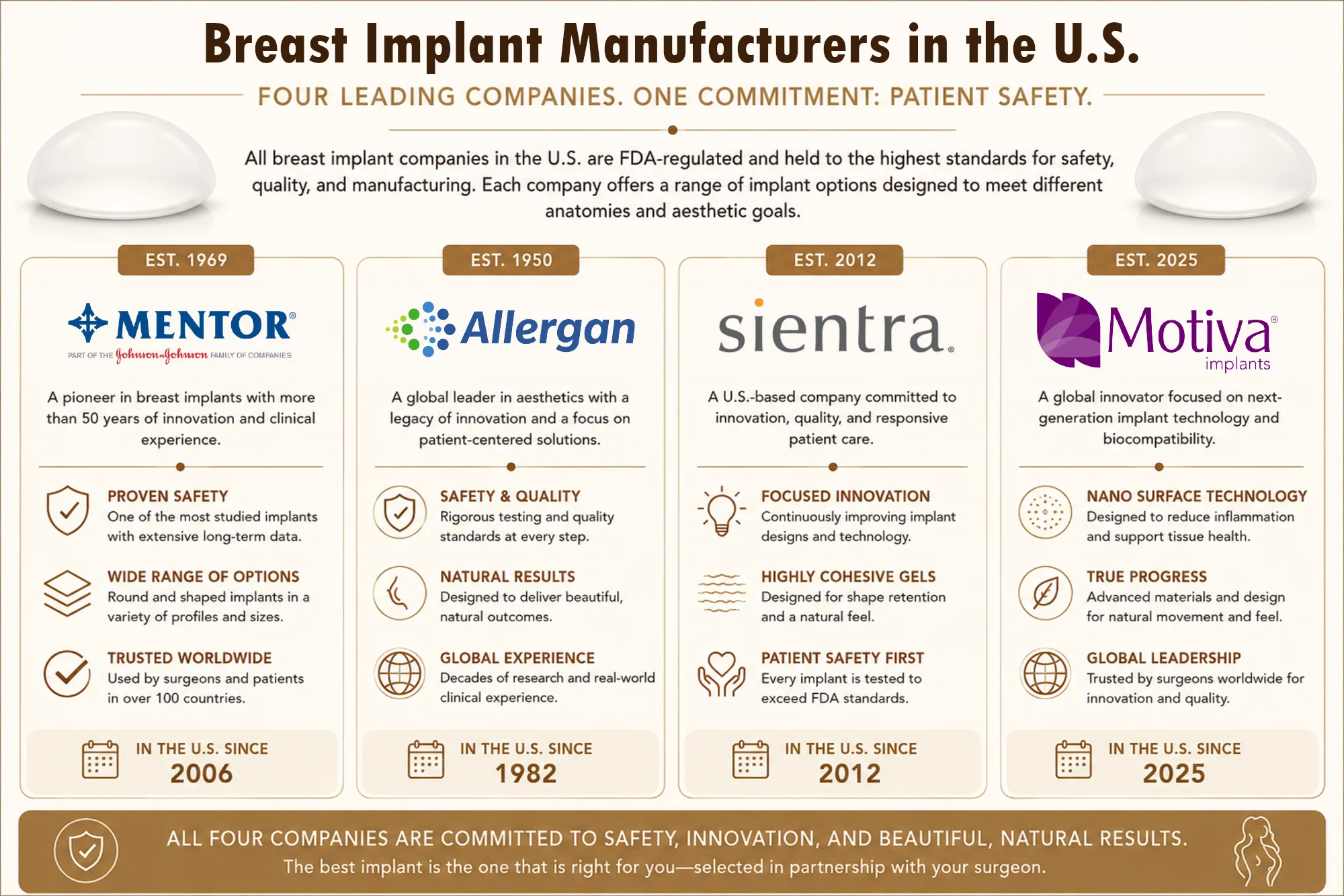
For many years following the FDA’s approval of silicone gel implants in 2006, the United States breast implant market was dominated by Mentor and Allergan.
In 2012, Sientra entered the U.S. market, providing surgeons and patients with another FDA-approved option. Sientra differentiated itself through its use of a highly cohesive silicone gel and a unique approach to implant design.
More recently, Motiva entered the U.S. market, bringing newer technologies developed from decades of international experience and introducing innovations focused on implant identification, shell technology, and a more natural interaction between the implant and surrounding tissues.
Mentor: A Legacy of Innovation
Mentor has been one of the most influential breast implant manufacturers in the world for decades. Today, Mentor is part of Johnson & Johnson MedTech and remains one of the most widely used implant systems in the United States. Mentor implants are known for:
- Extensive clinical data and long-term follow-up
- A broad range of implant sizes, profiles, and shapes
- Consistent manufacturing quality
- Strong surgeon familiarity and worldwide experience
Mentor’s MemoryGel® implants use cohesive silicone gel designed to maintain shape while providing a natural feel.
One of Mentor’s strengths is the breadth of its implant portfolio. The company offers surgeons a wide range of choices, allowing customization based on chest width, breast tissue thickness, desired fullness, and aesthetic goals.
Real Patient Example


Sensitive Content
These before and after photos contain nudity. Please click/tap to view the images.
This 45-year-old woman had previously undergone breast augmentation in our practice approximately 12 years earlier using 350 cc Mentor implants. When she returned for revision surgery, she elected to go slightly larger. Her implants were exchanged for 440 cc Mentor implants, maintaining their position below the muscle. This case provides a useful visual example of what increasing implant volume by approximately 100 cc actually accomplishes. The change is noticeable but modest—providing additional fullness and volume without creating a dramatic difference in overall breast size.
It is a helpful reminder that relatively small differences in implant volume often produce more subtle changes than patients might expect.
Allergan: The Natrelle Implant System
Allergan has also played a major role in shaping modern breast augmentation. The Natrelle® implant system has been widely used throughout the world and offers extensive options in implant size, projection, and gel cohesivity. Allergan implants are known for:
- A large database of clinical experience
- A wide range of implant dimensions
- Multiple gel cohesivity options
- Extensive research and development
The Natrelle Inspira® line was designed to provide surgeons with different levels of gel fill and cohesivity, allowing more precise control over implant feel and appearance.
Allergan’s implant designs have been particularly influential in the development of shaped and highly cohesive implants.
Real Patient Example


Sensitive Content
These before and after photos contain nudity. Please click/tap to view the images.
This patient from Walnut Creek, California, presented for breast augmentation revision after previously undergoing a circumareolar mastopexy, also known as a Benelli lift. As demonstrated in her preoperative photographs, she had persistent breast ptosis along with enlarged areolas—two limitations that can be seen with this approach. For her revision, we downsized her implants to more frame-appropriate 235 cc Allergan silicone gel implants, maintained their position below the muscle, and performed an anchor-style breast lift.
Her six-month result demonstrates beautiful symmetry, appropriately sized areolas, and a perkier, more youthful breast shape. This case illustrates why the right lift is just as important as the right implant. When significant reshaping and control of the areola are needed, an anchor lift can provide a more predictable and refined result than a circumareolar approach.
Sientra: A Different Approach to Implant Design
Sientra received FDA approval in 2012 and entered the market with a unique philosophy regarding implant design. One of Sientra’s distinguishing features is the use of a more highly cohesive silicone gel combined with a smooth or textured shell platform. Sientra implants are known for:
- Highly cohesive silicone gel
- A natural feel with shape stability
- A broad selection of implant dimensions
- Strong emphasis on implant integrity
Sientra was also the first breast implant manufacturer to receive FDA approval based on data from a prospective, long-term clinical study with a focus on breast implant safety and performance.
Real Patient Example
Sensitive Content
These before and after photos contain nudity. Please click/tap to view the images.
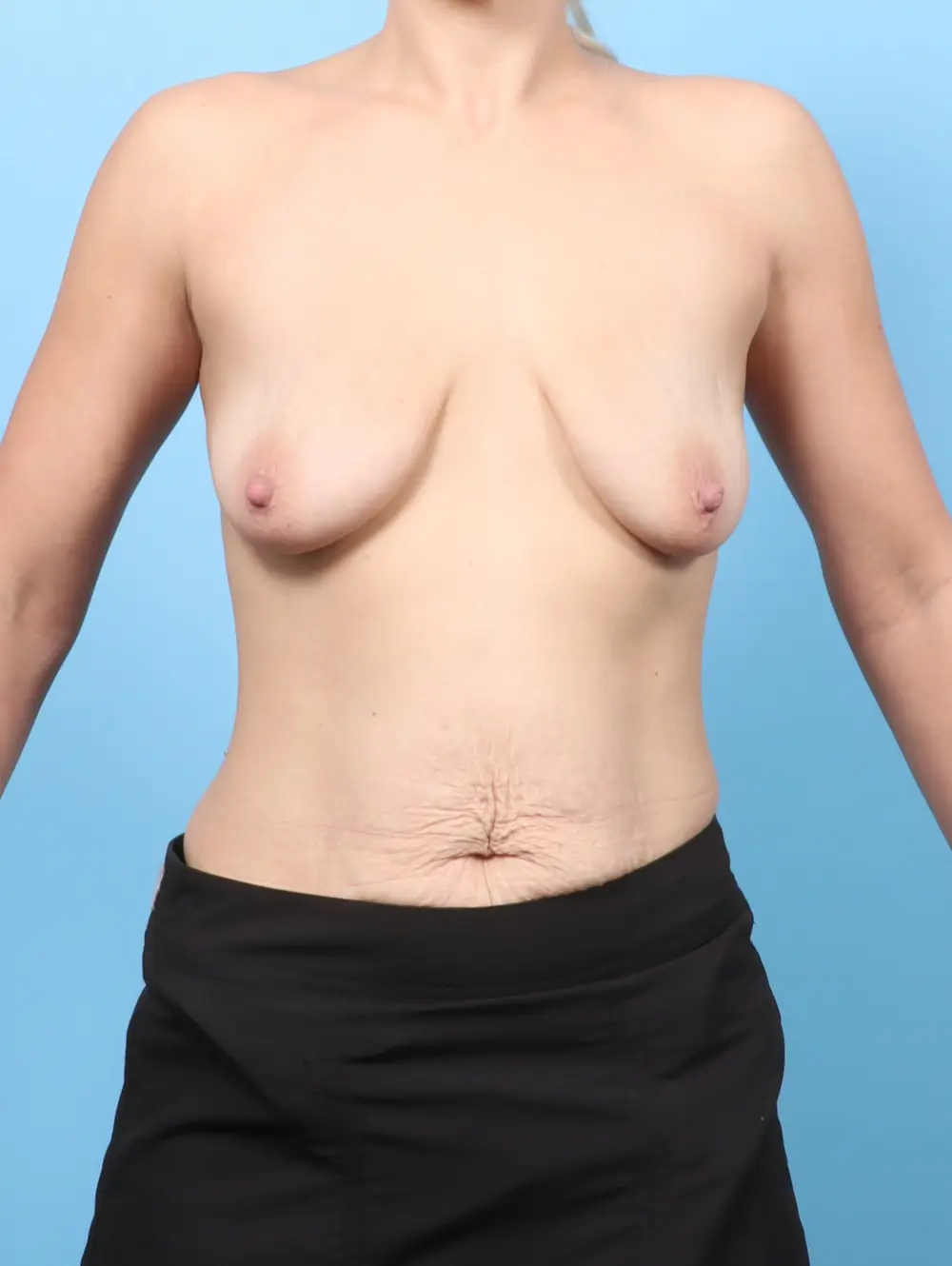
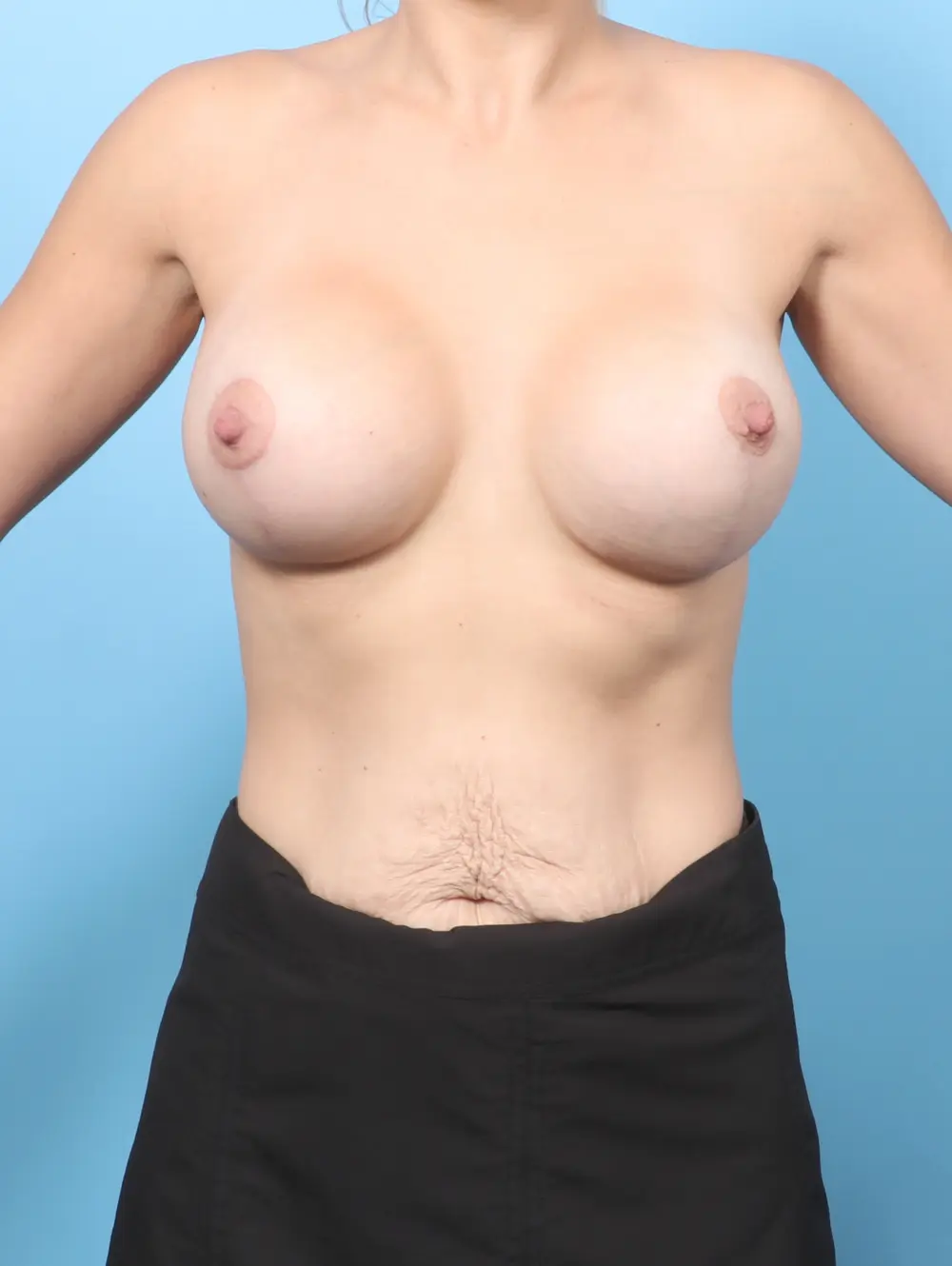
This 33-year-old woman from Rancho Cucamonga, California, is 5'5" and approximately 125 pounds. Following multiple pregnancies, she presented with significant breast deflation and desired a fuller, more visibly augmented appearance.
She underwent breast augmentation with 470 cc high-profile implants combined with a breast lift. The lift allowed us to improve breast symmetry and areolar shape while restoring the volume that had been lost with pregnancy.
Her result demonstrates fuller, shapelier breasts with improved symmetry and a more pronounced augmented appearance—exactly as she desired.
This case highlights an important principle: a natural result does not mean every patient needs to look the same. The goal is to create a breast shape and size that complements the patient's anatomy while reflecting her individual aesthetic goals.
Motiva: The Newest Generation of Breast Implant Technology
Motiva represents the newest major entrant into the U.S. breast implant market. The company was founded with the goal of developing implants that more closely mimic the behavior of natural breast tissue. Motiva implants incorporate several newer concepts:
- ProgressiveGel® silicone technology
- Advanced shell design
- Enhanced implant flexibility
- Q Inside Safety Technology™ (a small RFID microtransponder embedded in select implants that allows implant identification) – This technology is not available in the US.
One of the concepts behind Motiva is that the ideal implant should not simply provide volume – it should interact naturally with the patient’s body and maintain a soft, natural appearance over time.
As with any newer technology, long-term data collection continues, and ongoing follow-up will help define the role Motiva will play in the future of breast augmentation.
Real Patient Example

Sensitive Content
These before and after photos contain nudity. Please click/tap to view the images.
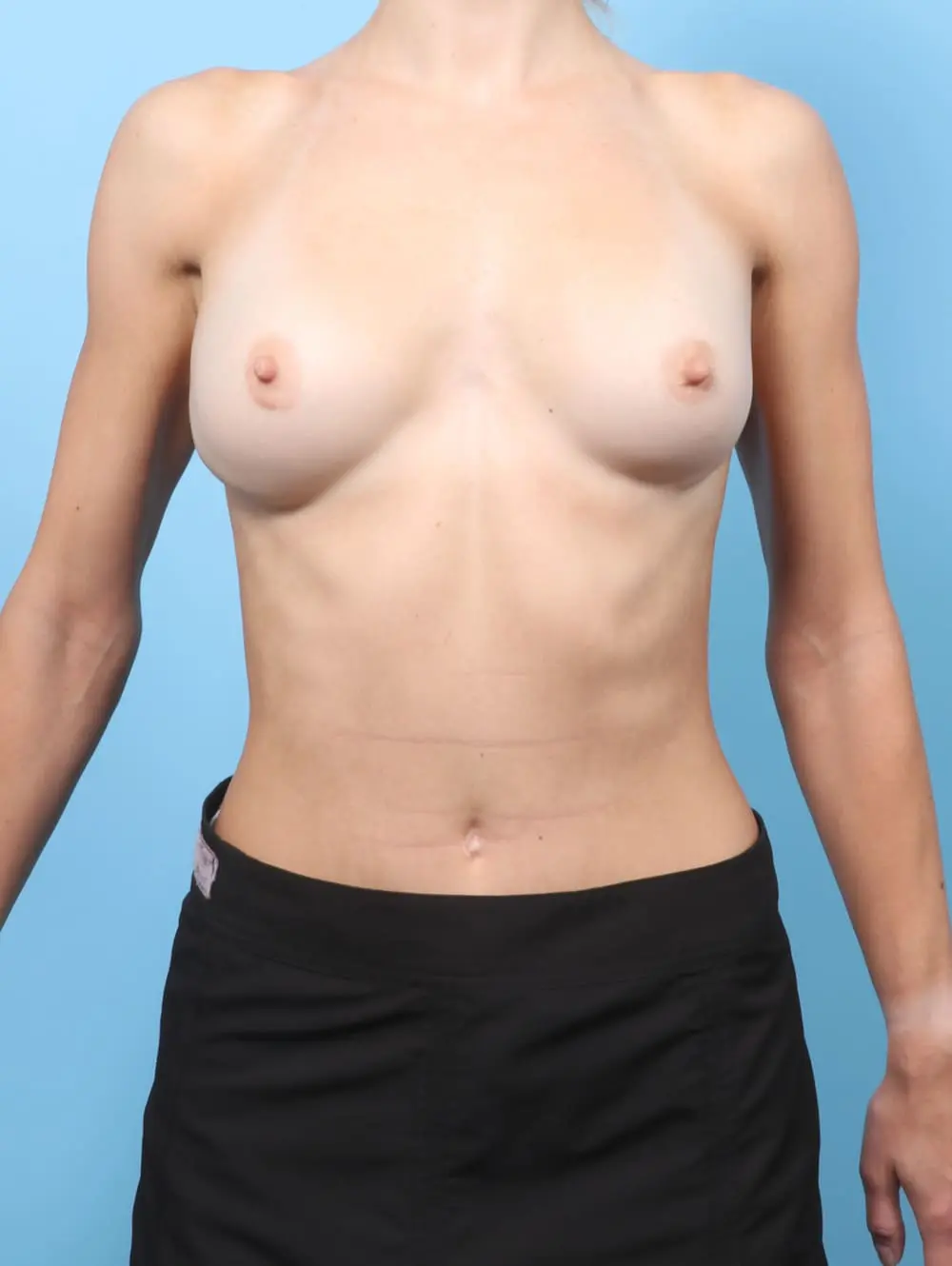
This 29-year-old woman from Modesto, California, is 5'9" and approximately 133 pounds. She previously had implants placed below the muscle and was bothered by significant animation deformity as well as lateral displacement of her implants. For her revision, we used an inframammary fold approach to reposition the implants above the muscle in a subfascial plane, adding an internal bra for additional support and control of implant position. The implants selected were Motiva, SmoothSilk 450cc Full profile.
Her result maintains natural, size-appropriate proportions while addressing the concerns that brought her back to surgery. Her animation deformity has been eliminated, implant position is improved, and she has enhanced cleavage. This case nicely demonstrates how changing the implant pocket can solve problems that changing the implant alone cannot. Careful pocket selection and internal support can improve both breast appearance and implant behavior.
Choosing a Breast Implant Manufacturer

All FDA-approved breast implants available today have undergone extensive testing and evaluation. The differences between manufacturers are not about one implant being “safe” and another being “unsafe.” Rather, the differences relate to engineering choices – how the implant is constructed, how it feels, how it maintains shape, and how it interacts with the patient’s anatomy.
The implant manufacturer is only one piece of the equation. A surgeon who understands the nuances of all available implants can use different devices to achieve excellent outcomes. A beautiful breast augmentation result depends on:
- Choosing the correct implant dimensions
- Matching implant characteristics to the patient’s anatomy
- Selecting the appropriate pocket location
- Creating precise surgical technique
- Understanding the patient’s goals
Mentor, Allergan, Sientra, and Motiva all produce excellent implants. Each has unique characteristics, and each can be the right choice for the right patient. Our practice does not promote one implant company over another. Our surgeons have a deep understanding of the differences between these devices and use that knowledge to create the most natural, beautiful, and long-lasting result possible for each individual patient.
Breast Implant Shell Technology
When our patients think about breast implants, they often focus primarily on what is inside the implant – the silicone gel. However, the outer shell of the implant is equally important.
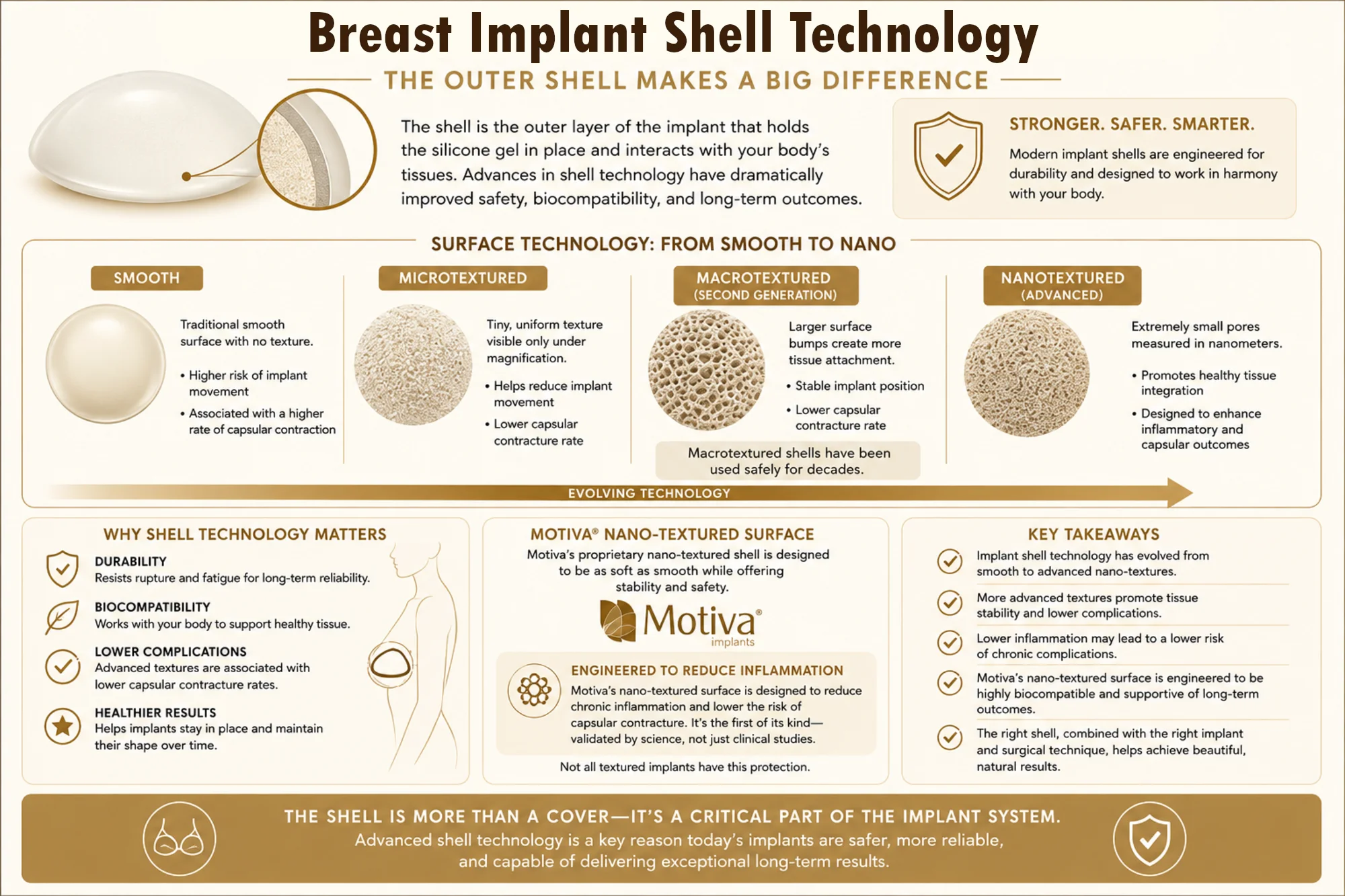
The shell is the surface that directly interfaces with the patient’s tissues. It influences how the implant interacts with the surrounding capsule, how the implant moves within the breast pocket, and how the body’s immune system responds to the presence of the device.
Every breast implant currently used in the United States is made with a silicone elastomer outer shell. The differences between manufacturers involve how that shell is engineered, the characteristics of the surface, and the way that surface interacts with the biology of the human body.
Understanding implant shell technology helps explain why different implants may behave differently and why surgeons consider more than simply implant size when choosing the right device for a patient.
The Evolution of Implant Shell Technology
The history of breast implant shell design is a story of balancing two competing goals:
- Creating a breast that looks and feels natural.
- Minimizing complications such as capsular contracture, implant malposition, and tissue irritation.
Early silicone breast implants utilized relatively smooth silicone shells. As implant technology evolved, manufacturers began exploring different surface characteristics in an attempt to improve implant stability and reduce complications.
This led to the development of textured implant surfaces. Textured implants were designed to encourage tissue adherence to the implant surface. The theory was that stronger interaction between the implant and surrounding tissues could reduce implant movement, prevent rotation of shaped implants, and potentially decrease capsular contracture.
However, as our understanding of implant biology improved, concerns emerged regarding the relationship between certain textured implants and breast implant-associated anaplastic large cell lymphoma (BIA-ALCL), a rare type of lymphoma associated primarily with textured implants.
This discovery significantly changed the breast implant landscape. Many textured implants were removed from the market, and the field has shifted toward smoother and more biologically refined implant surfaces.
The Body Forms a Capsule Around Every Breast Implant
Whenever a medical device is placed into the human body, the body naturally creates a thin layer of scar tissue around it. This is called a capsule.
A thin, soft capsule is normal and expected. It is the body’s natural way of isolating a foreign object. Capsular contracture occurs when this capsule becomes unusually thick, tight, or firm and begins to squeeze the implant. This can result in firmness, distortion, discomfort, or changes in breast appearance.
Understanding how implant surfaces influence the body’s healing response is one of the major areas of modern breast implant research. The goal of newer implant technologies is not to eliminate the body’s natural healing response, but rather to encourage a more balanced and harmonious interaction between the implant and the patient’s tissues.
Mentor Shell Technology
Mentor has been one of the most influential breast implant manufacturers in the world for decades. The company’s implants have extensive clinical experience and long-term follow-up data.
Mentor’s current silicone implants utilize smooth shell technology designed to provide:
- A natural interaction between implant and surrounding tissue
- Implant mobility within the breast pocket
- Long-term clinical predictability
One of the advantages of smooth implants is that they allow the implant to move naturally within the breast pocket. This mobility can help create a more natural appearance and feel.
Mentor’s extensive clinical history has provided surgeons with decades of experience understanding how these implants behave over time.
Allergan Natrelle Shell Technology
Allergan has played a major role in the evolution of modern breast implants. The Natrelle® implant system has been widely used throughout the world and has contributed significantly to breast implant innovation.
Historically, Allergan offered both smooth and textured implant surfaces. Its Biocell® textured implant surface was designed to improve tissue adherence and reduce movement, particularly with shaped anatomical implants.
However, after concerns emerged regarding the association between certain textured implants and BIA-ALCL, Allergan’s Biocell textured implants were withdrawn from many markets.
Today’s Allergan implant options emphasize smooth shell technology, with a focus on:
- Natural tissue interaction
- Predictable implant behavior
- Extensive clinical experience
- Broad implant customization options
The history of Allergan’s textured implants highlights an important lesson in medical device development: innovation requires continuous evaluation of both benefits and potential risks.
Sientra Shell Technology
Sientra entered the United States breast implant market in 2012 and brought another FDA-approved option to surgeons and patients.
Sientra’s implant philosophy has emphasized:
- Highly cohesive silicone gel technology
- Implant integrity
- Controlled shell design
- Predictable long-term performance
Sientra has offered both smooth and textured implant options, although the modern breast implant market has increasingly moved toward smooth surface technology.
The company’s contribution to breast implant development has centered on combining cohesive gel technology with carefully engineered implant construction.
Motiva Shell Technology
Motiva represents one of the newest generations of breast implant technology and approaches the implant-tissue relationship from a different perspective. Historically, implant surface design focused primarily on mechanical goals:
- Preventing implant movement
- Reducing rotation
- Improving stability
However, modern research has demonstrated that the implant surface is not simply a mechanical interface – it is a biological interface.
The body’s response to an implant involves a complex interaction between inflammatory cells, fibroblasts, collagen production, and scar formation.
Motiva’s SmoothSilk®/SilkSurface® technology was designed with the goal of creating a more harmonious interaction between the implant and surrounding tissues.
Rather than creating a surface that aggressively encourages tissue adherence, Motiva’s nanotextured surface was engineered to create a controlled, low-friction environment that may reduce mechanical irritation and influence the body’s inflammatory response.
The Science Behind Nanotexturing
Fibroblasts are connective tissue cells that play a central role in wound healing and scar formation. When activated excessively, fibroblasts can contribute to increased collagen deposition and fibrosis, which is one of the mechanisms involved in capsular contracture.
Research examining implant surface characteristics has demonstrated that surface topography can influence fibroblast behavior and the inflammatory response at the implant-tissue interface.
Studies published in Nature journals have explored how nanotextured implant surfaces may reduce inflammatory signaling pathways, decrease fibrotic responses, and create a more favorable interaction between the implant and surrounding tissues.
The proposed mechanism is that nanotexturing may reduce fibroblast activation and decrease the inflammatory cascade that contributes to excessive scar formation.
This represents a significant evolution in implant design philosophy:
- Previous generations of implant design asked: “How do we make the implant stay where we put it?”
- Newer generations ask: “How do we create an implant surface that works more harmoniously with the human body?”
This concept of biomimetic design – creating medical devices that interact more naturally with biology – is one of the most exciting areas of breast implant research today.
Comparing Implant Shell Technologies
| Manufacturer | Current Surface Philosophy | Key Concept |
|---|---|---|
| Mentor | Smooth silicone shell technology | Predictability, extensive clinical experience, and long-term data |
| Allergan | Primarily smooth surface technology today | Broad experience and extensive implant options |
| Sientra | Smooth surface technology with emphasis on implant integrity | Cohesive gel combined with controlled implant design |
| Motiva | SmoothSilk®/nanotextured surface technology | Optimizing implant-tissue interaction through surface engineering |
Our Perspective
The shell of a breast implant is where the device meets the body, and this interaction represents one of the most important areas of ongoing implant evolution.
Historically, textured implants were developed with a logical goal: to improve implant stability and potentially reduce capsular contracture. However, as our understanding of implant biology has advanced, we have learned that the relationship between an implant and the human body is far more complex than simply whether tissue adheres to the surface.
The concept behind Motiva’s nanotextured surface technology is particularly compelling because it represents a shift in philosophy. Instead of creating a surface designed to aggressively interact with tissue, the goal is to create a more biologically harmonious interface.
The future of breast implant technology is not simply about making implants larger, softer, or more durable. It is about designing implants that interact more naturally with the patient’s tissues.
While all FDA-approved breast implants available today are excellent medical devices, the movement toward more biocompatible surfaces represents one of the most exciting directions in breast implant evolution.
The ultimate goal is not simply placing an implant in the body. The goal is creating a result where the implant and the patient’s tissues coexist as naturally as possible.
Breast Implant Gel Technology
When patients research breast implants, one of the most common terms they encounter is “gummy bear implant.”
This term has become popular because modern silicone implants contain a more cohesive gel than implants from previous generations. However, many patients assume that “gummy bear” automatically means better.
The reality is more nuanced. Modern silicone breast implants are not all filled with the same type of gel. Each manufacturer has developed its own silicone gel formulation with different characteristics of softness, shape retention, and cohesivity.
Understanding gel technology is important because the type of silicone gel inside an implant influences:
- How soft the breast feels
- How well the implant maintains its shape
- How much upper pole fullness it provides
- The likelihood of visible rippling
- How natural the breast feels over time
The goal is not simply choosing the most cohesive implant. The goal is choosing the implant with the characteristics that best match the patient’s anatomy and aesthetic goals.
What Is Silicone Gel Cohesivity?
Cohesivity refers to the ability of silicone gel molecules to stick together and maintain their structure. A simple way to understand cohesivity is to think about the difference between:
- A very soft gelatin dessert that spreads easily
- A firmer gummy candy that maintains its shape when handled
Both are gels, but their behavior is different. In breast implants, a less cohesive gel is softer and more fluid, while a highly cohesive gel maintains more of its shape.
Modern implants use silicone gels that fall along a spectrum of cohesivity rather than simply being “soft” or “firm.”
The Benefits of Increased Cohesivity
Increasing gel cohesivity provides several potential advantages:
- Improved Shape Stability: A more cohesive gel helps the implant maintain its intended shape. This is particularly important with shaped implants, where the implant is designed to have a specific upper and lower contour.
- Increased Upper Pole Fullness: More cohesive gels tend to resist downward settling and can provide more consistent fullness in the upper portion of the breast. This can be desirable for patients who want a fuller, more augmented appearance.
- Reduced Rippling: Rippling occurs when folds or waves in the implant become visible or palpable through the breast tissue. Highly cohesive gels are generally more resistant to folding and implant edge visibility, particularly in patients with thin breast tissue and minimal natural breast volume.
Softness vs Shape Retention
The most important concept patients should understand is that every implant represents a balance.
A softer gel may provide:
- A softer feel
- More natural movement
- A less “augmented” sensation
A more cohesive gel may provide:
- Greater shape stability
- More upper pole fullness
- Less rippling
- More predictable contour
However, the tradeoff is that a more cohesive implant is generally firmer. The goal is not to choose the firmest implant possible. The goal is to choose the implant that provides the desired appearance while maintaining a natural feel.
More about “Gummy Bear” Implants
The term “gummy bear implant” comes from the behavior of highly cohesive silicone gel. If you cut a gummy bear candy in half, it maintains its shape rather than flowing apart. Similarly, highly cohesive silicone gel maintains its structure when cut.
However, breast implants are far more sophisticated than a gummy candy. They are engineered medical devices with carefully designed shells and gel formulations that are studied extensively for safety, durability, and performance.
The goal is not to create the firmest implant possible. The goal is to create an implant that provides the ideal balance of shape, softness, and natural appearance.

Cohesivity by Manufacturer
Each implant manufacturer has developed its own philosophy regarding silicone gel technology.
- Mentor: Mentor’s MemoryGel® implants have a long history of clinical use and are available in different levels of gel cohesivity. The company emphasizes providing a range of options, allowing surgeons to select implants based on the patient’s anatomy and desired result. Mentor’s MemoryGel Xtra® implants offer increased fill and cohesivity designed to provide more upper pole fullness, increased shape stability and reduced rippling while maintaining a natural feel.
- Allergan Natrelle: Allergan’s Natrelle INSPIRA® line was designed around the concept that patients benefit from different levels of gel fill and cohesivity. Rather than a single gel formulation, Allergan offers a spectrum of implants designed to provide varying degrees of softness, firmness, projection and shape retention. This allows surgeons to customize implant selection more precisely.
- Sientra: Sientra entered the market with a strong emphasis on highly cohesive silicone gel technology. Sientra implants are known for high gel cohesivity, shape stability and reduced gel movement within the shell. The company’s approach has focused on maintaining implant form while still providing a natural feel.
- Motiva: Motiva’s approach to gel technology combines cohesivity with the concept of dynamic behavior. Motiva’s ProgressiveGel® technology is designed to provide different levels of support and softness depending on the implant design. The philosophy is that an ideal implant should maintain enough structure to create a beautiful breast shape while still allowing natural movement and softness. Motiva’s goal is not simply maximum cohesivity – it is creating an implant that behaves more like natural breast tissue.
Comparing Implant Gel Philosophy
| Manufacturer | Gel Philosophy | Primary Concept |
|---|---|---|
| Mentor | Multiple cohesive gel options | Customization and predictability |
| Allergan | Spectrum of gel fill and cohesivity | Fine-tuning softness and shape |
| Sientra | Highly cohesive gel technology | Shape stability and reduced rippling |
| Motiva | ProgressiveGel® technology | Balance between support and natural movement |
Our Perspective
The most important lesson about silicone gel is that there is no universally “best” cohesivity.
A common misconception is that the newest or firmest implant must automatically be superior. In reality, every patient presents a unique combination of anatomy, tissue thickness, lifestyle, and aesthetic goals.
For a patient with very thin breast tissue, a more cohesive implant may provide important advantages by reducing visible rippling and improving contour. For another patient with adequate breast tissue who wants the softest, most natural-feeling result possible, a softer implant may be the better choice.
The art of breast augmentation is finding the right balance between softness and structure. The ideal implant should provide enough support to create a beautiful breast shape while maintaining the natural movement and feel that patients desire.
Breast Implant Shape and Profile
One of the most common misconceptions in breast augmentation is that patients choose their implant by selecting a “high profile” or a “moderate profile.”
In reality, implant profile is only one part of the equation. The final appearance of your breasts depends on a combination of:
- Implant width
- Implant projection (profile)
- Implant volume
- Gel cohesivity
- Your existing breast tissue
- Your chest wall anatomy
- Surgical technique
Understanding implant profile allows patients to appreciate why two implants with exactly the same volume can create very different breast shapes.
Implant Shape: Round vs. Anatomical
Modern breast implants are available in two basic shapes:
Round Implants
Round implants are symmetrical. No matter how the implant rotates, the breast maintains the same appearance because every portion of the implant has the same shape.
When a woman is standing, gravity naturally causes the silicone gel within a round implant to settle slightly toward the lower portion of the breast, creating a gentle teardrop appearance.
A properly selected round implant often produces the same natural breast contour patients believe requires an anatomical implant.
Anatomically Shaped (“Teardrop”) Implants
Anatomical implants were designed to permanently maintain a teardrop shape. The concept was appealing:
- Less fullness in the upper breast
- More volume in the lower breast
- A permanently “natural” contour
However, shaped implants introduce several important disadvantages. Because they have a defined top and bottom, they must remain in exactly the correct position.
If the implant rotates, the breast can become noticeably distorted and may require another operation to correct the problem.
Historically, anatomical implants also relied on textured shells to reduce rotation. As our understanding of textured implants has evolved, the popularity of anatomical implants has declined significantly. For the overwhelming majority of cosmetic breast augmentation patients, we believe round implants are the superior choice.

Understanding Implant Profile
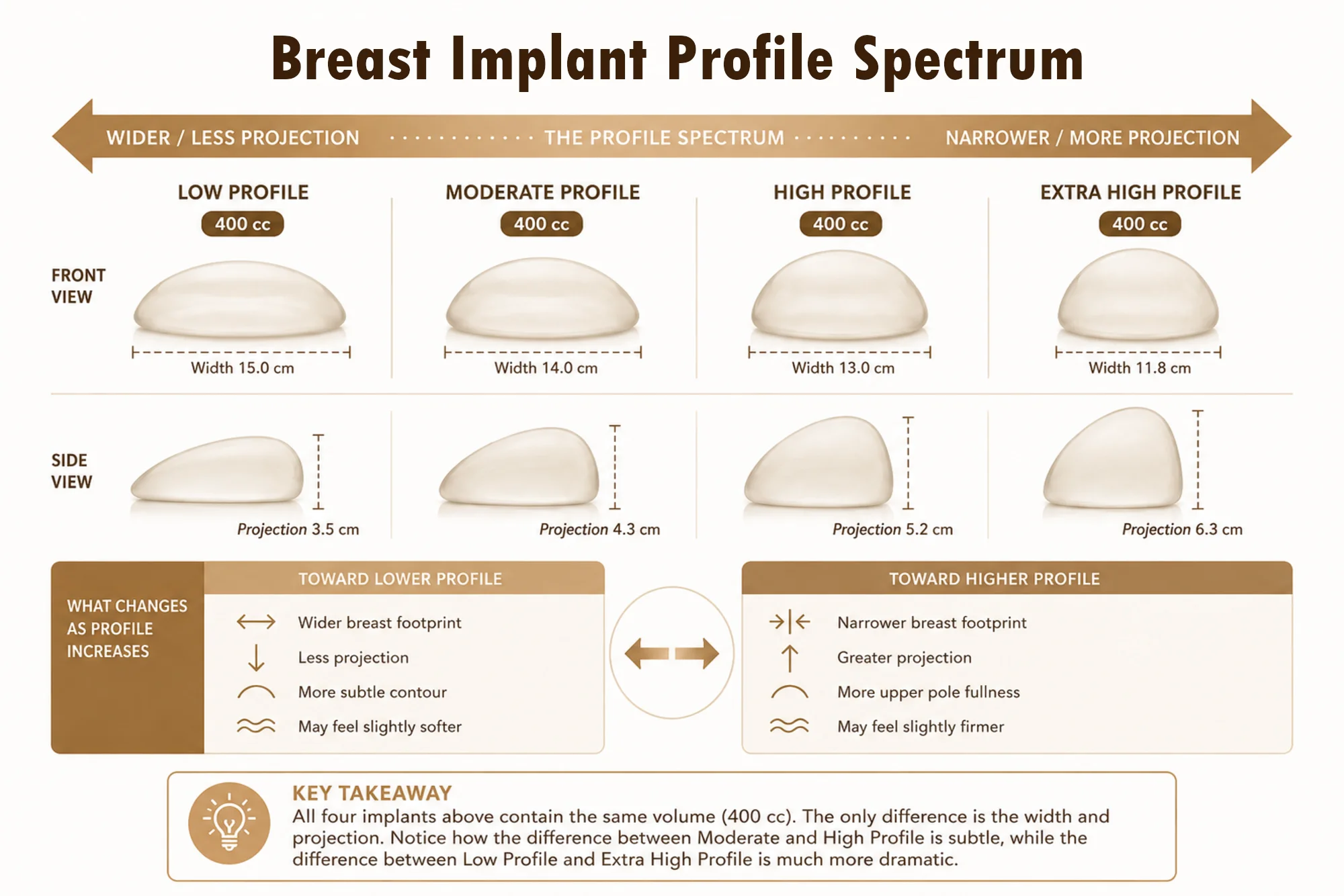
Implant profile is defined as how much of the implant projects forward compared with how wide it is. Imagine taking the same amount of silicone and shaping it into different cylinders.
- A wider cylinder becomes flatter.
- A narrower cylinder becomes taller.
The volume is identical; only the shape changes. That is what implant profile is all about.
Here’s another way to think about it: imagine placing the same amount of mashed potatoes on different dinner plates. On a large dinner plate, the potatoes spread out – they become wider but flatter. On a small plate, the potatoes stack higher – they project more. The amount hasn’t changed, only the shape has.
The Profile Spectrum
Low Profile
- Widest implant
- Least projection
- Broad breast footprint
- More subtle anterior fullness
Best suited for women with broad chest dimensions who desire a conservative result.
Moderate Profile
- Slightly narrower
- Slightly more projection
- Balanced proportions
- Very natural appearance
Moderate profile implants remain one of the most versatile implant designs.
Moderate Plus / High Profile
- Modestly narrower than moderate-profile implants
- Likewise, they project only modestly more
Many patients expect an enormous difference between moderate and high profile. In reality, when viewed side by side, the differences are often surprisingly subtle. The choice is more about fine-tuning breast proportions than dramatically changing appearance.
Extra High Profile
- Significantly narrower than other implant profiles
- Project substantially farther from the chest wall
These implants may be appropriate in selected patients with narrow chest dimensions who desire greater projection while maintaining a limited implant width.
Profile Is About Geometry
One of the most important concepts patients should understand is this: Profile does NOT determine implant size.
A 350 cc implant can be:
- Moderate profile
- High profile
- Extra-high profile
The volume remains exactly the same. Only the relationship between width and projection changes. This means that two 350 cc implants can look completely different. A wider implant spreads that volume across a broader base, creating a flatter appearance. A narrower implant concentrates that same volume into a smaller footprint, creating greater projection.
The amount of silicone is identical. Only the geometry changes!
Comparing Implant Profiles
| Profile | Width | Projection | Typical Appearance |
|---|---|---|---|
| Low | Widest | Least | Broad, subtle enhancement |
| Moderate | Wide | Moderate | Balanced, natural contour |
| High | Slightly narrower | Slightly greater | Increased projection with minimal change in width |
| Extra High | Narrowest | Greatest | Maximum projection for a given implant volume |
Our Perspective
One of the biggest misconceptions our surgeons often hear is that patients believe a high-profile implant automatically creates an artificial appearance.
That simply isn’t true. Profile is a geometric measurement, not an aesthetic judgment.
The difference between a moderate-profile and a high-profile implant is actually quite subtle. Both can produce beautiful, natural results when matched appropriately to a patient’s anatomy.
The larger visual difference occurs when comparing the extremes – a low-profile implant versus an extra-high-profile implant. When selecting an implant, our surgeons don’t start by asking whether the patient wants moderate or high profile. Instead, they measure chest width and breast dimensions, review tissue characteristics, and discuss the desired aesthetic outcome..
Choosing a Breast Implant Size
One of the first questions every patient asks is: “What size implant should I get?”
It’s a perfectly reasonable question – but it isn’t actually the right question. The better question is: “What implant will create the appearance I’m hoping to achieve while fitting my anatomy?”
Choosing a breast implant is not like buying shoes or ordering clothing in a particular size. Two women choosing a 350 cc implant may have completely different results because their chest width, breast tissue, skin elasticity, and body proportions are different.
The goal is not simply choosing a volume. The goal is selecting an implant that creates a balanced, beautiful, and natural result.
There Is No Perfect Formula
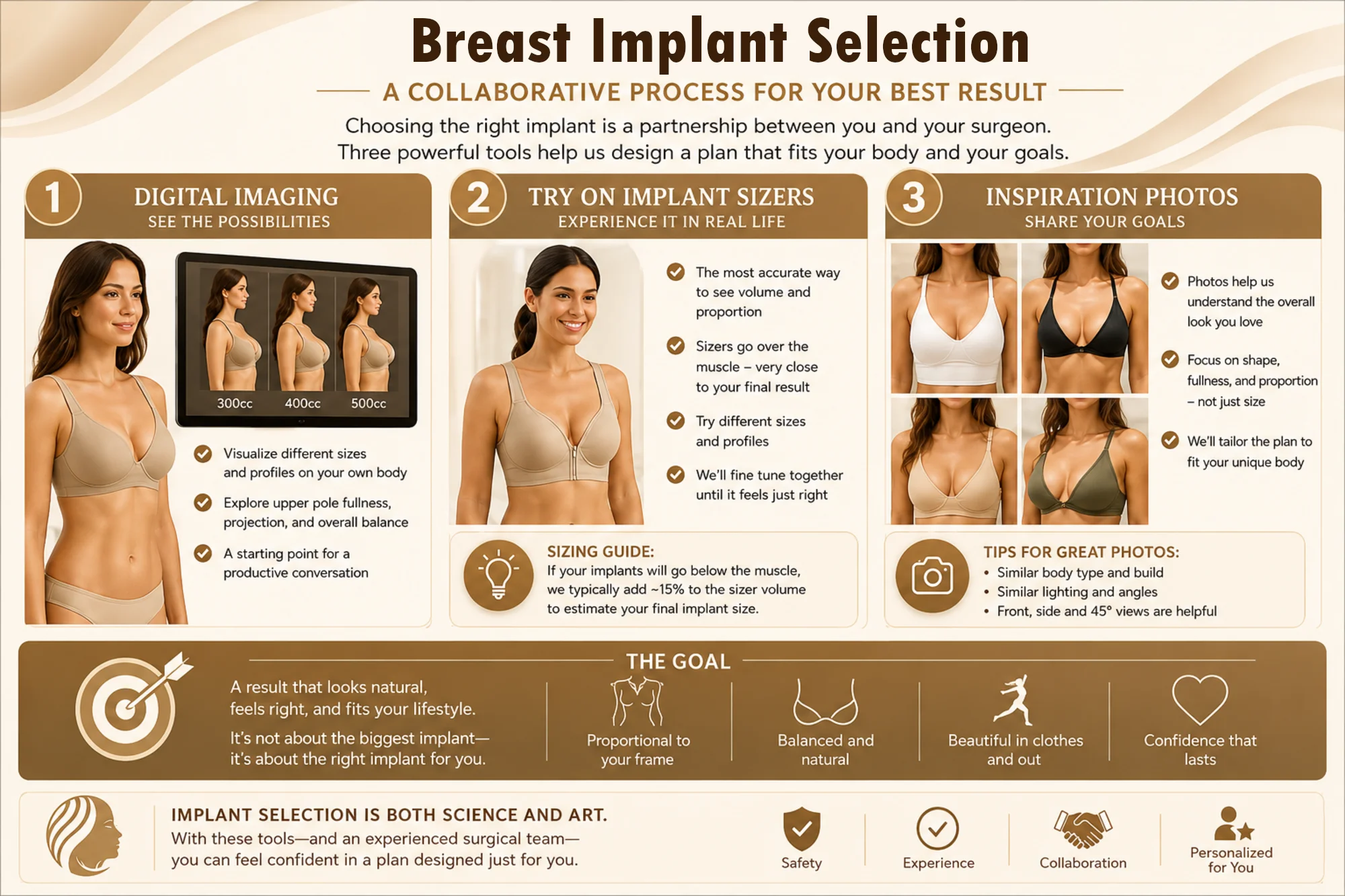
Over the years, surgeons have developed many methods to help patients choose an implant. These include:
- Digital 3-dimensional imaging
- Implant sizing systems
- Trial implant sizers worn inside a bra
- Before-and-after photographs
- Patient “wish pictures”
- Anatomical measurements
- Surgeon experience
Each method has strengths and limitations. The best results usually come from combining several of these tools rather than relying on any single technique.
Digital Imaging
3D imaging technology is a key tool for us to help shape the conversation when discussing breast implant size during a consultation. It can help patients visualize possible outcomes and improve communication. However, digital imaging has important limitations.
Computer simulations cannot accurately predict:
- Tissue stretch
- Healing
- Implant settling
- Skin elasticity
- Individual scar formation
For these reasons, we view digital imaging as a communication tool rather than a prediction of the final surgical result.
Inspiration Photographs
One of the most valuable parts of any consultation is reviewing photographs that patients bring with them. These images help our plastic surgeons understand what the patient finds attractive.
More importantly, they help us establish a common language. For example:
- “I like the upper fullness in this photo.”
- “I want cleavage like this.”
- “I want to stay very natural.”
- “I definitely don’t want this look.”
The photographs are never used as a blueprint. Instead, they help us understand your aesthetic goals a little better. So be on the lookout for the breast size and shape you like, whether you find those images in our photo gallery, on social media, or elsewhere.
Implant Sizers
Implant sizers remain one of the most valuable tools for choosing implant size, and we use them all the time during consultations at The Natural Result. After discussing your goals, we will ask you to place implant sizers inside a supportive bra while wearing a fitted shirt.
This allows you to see yourself from multiple angles, move naturally, and appreciate how different implant sizes change your overall body proportions. Many patients immediately recognize when they have found the appearance they were hoping for.
It becomes much less about cubic centimeters and much more about how they feel when they look in the mirror.
Adjustment for Implant Position
One important detail that many patients don’t realize is that implant position affects the appearance of the sizer.
- If the implant will be placed above the muscle, the sizer worn inside the bra provides a very accurate estimate of the final volume.
- However, if the implant will be placed below the pectoralis muscle, the muscle compresses the implant to some degree during the early healing period.
For that reason, our surgeons generally increase the selected implant volume by approximately 15% when converting from an above-the-muscle bra sizer to a planned submuscular augmentation. This simple adjustment has consistently provided a remarkably accurate guide to achieve a satisfying outcome.
The Most Important Measurement: Implant Width
Although patients naturally focus on implant volume, our surgeons spend just as much time evaluating implant width. The width of the implant should closely match the natural footprint of the breast. This is one of the most important principles in breast augmentation.
If the implant is too wide:
- The breasts may extend too far toward the sides of the chest.
- The implants can crowd the armpits.
- The breasts may appear overly broad or unnatural.
If the implant is too narrow:
- There may be excessive space between the breasts.
- Cleavage can be difficult to achieve.
- The breasts may appear smaller than expected despite an adequate implant volume.
Proper implant width creates balance. The implant should fit the breast – not force the breast to fit the implant.
Putting It All Together
Choosing the right implant involves balancing several variables simultaneously:
- Your anatomy
- Your breast width
- Your tissue thickness
- Your desired fullness
- Implant profile
- Gel cohesivity
- Implant placement
- Surgical goals
No single measurement determines the answer. Instead, implant selection is the process of finding the combination that best fits your body. A good way to reframe the “size” question is to ask yourself instead, “When I look in the mirror after surgery, what do I hope to see?”
Some women want a subtle enhancement that no one will notice. Others want more upper pole fullness or a fuller, more dramatic appearance.
A combination of patient input, careful measurements, and surgical experience has become the foundation of our implant selection process at The Natural Result.
Breast Implant Warranties
One of the most common questions patients ask us is: “What happens if my implant ruptures years from now?”
Fortunately, today’s breast implant manufacturers stand behind their products with comprehensive warranty programs.
While every company structures its warranty a little differently, all major manufacturers provide protection against implant rupture and many also provide assistance for certain complications, such as severe capsular contracture.
Although warranties are reassuring, we encourage patients not to base their implant decision solely on warranty coverage. The most important decision is selecting the implant that best matches your anatomy, lifestyle, and aesthetic goals.
What Does an Implant Warranty Cover?
Most warranties include two types of protection.
- Implant Replacement: If an implant experiences a qualifying rupture or deflation, the manufacturer will generally provide replacement implant(s) at no cost. For silicone implants, this coverage is typically lifetime.
- Financial Assistance: Some manufacturers also provide financial assistance toward revision surgery for qualifying complications such as implant rupture, severe capsular contracture (Baker Grade III or IV), and certain other covered complications (depending on the manufacturer and program).
Coverage amounts and eligibility vary between companies.
- Mentor warranty coverage information
- Natrelle warranty coverage information
- Sientra warranty coverage information
- Motiva warranty coverage information
Does a Warranty Mean You’ll Never Need Another Surgery?
No.
A warranty protects the implant, not necessarily every cost associated with surgery. Women may choose additional breast surgery over their lifetime because of:
- Pregnancy
- Weight changes
- Aging
- Changes in aesthetic preferences
- Implant malposition
- Capsular contracture
- Implant rupture
Many of these situations are not considered product defects.
Today’s implants are remarkably durable, and true ruptures are uncommon, but it is reassuring to know that manufacturers provide meaningful support if a covered problem occurs. The differences in warranty coverage between today’s major manufacturers are relatively small compared with the importance of selecting the right implant size, profile, cohesivity, and surgical technique.
Our plastic surgeons choose implants based on their performance, feel, shape, safety profile, and how well they fit each patient’s anatomy. The warranty is certainly a nice benefit, but it’s not the reason we will recommend one implant over another.
Silicone Implant Catalogs
One of the biggest surprises for patients is discovering there isn’t just one breast implant. There are hundreds of implant combinations available. Every implant is defined by several characteristics:
- Manufacturer
- Implant profile
- Implant volume
- Implant width
- Projection
- Gel cohesivity
- Shell technology
Changing any one of these characteristics changes how the breast will ultimately look and feel. Each breast implant manufacturer publishes a full catalog of implant model numbers. We’ve linked to those below. You don’t need to go through and select your exact implant; we take care of that after deciding together what is best during your consultation.
Motiva
Sientra, a Tiger Aesthetics Company
- https://tiger-aesthetics.com/
- https://sientra.ca/wp-content/uploads/2023/09/MDC-0780-R2-Canada-Implants-Quick-Reference-Guide.pdf
Mentor, a Johnson and Johnson subsidiary
- https://www.jnjmedtech.com/en-US/products/aesthetics-and-reconstructive-surgery/breast-augmentation
- https://p1.aprimocdn.net/jjamp/en/order-form/product-catalog-2025-us-mnt-brst-169630–3–1001375.pdf
Natrelle Breast Implants, a subsidiary of Allergan
Request Your Consult
Meet Our Doctors
Our surgeons are dedicated to creating beautiful, natural results so you can look and feel your very best.